What an AI connector is, and why people call it MCP
An AI connector gives your assistant live access to a business tool so it can read and act without exports. What the term means, what MCP has to do with it, and the question to ask first.

An AI connector is an integration that gives an AI assistant live, authenticated access to a specific piece of business software, so the assistant can read data from and take actions inside that tool without you exporting files or leaving the chat. Most current implementations use MCP (Model Context Protocol), an open standard for exposing a tool's capabilities to an AI client.
Why does everyone say MCP instead of connector?
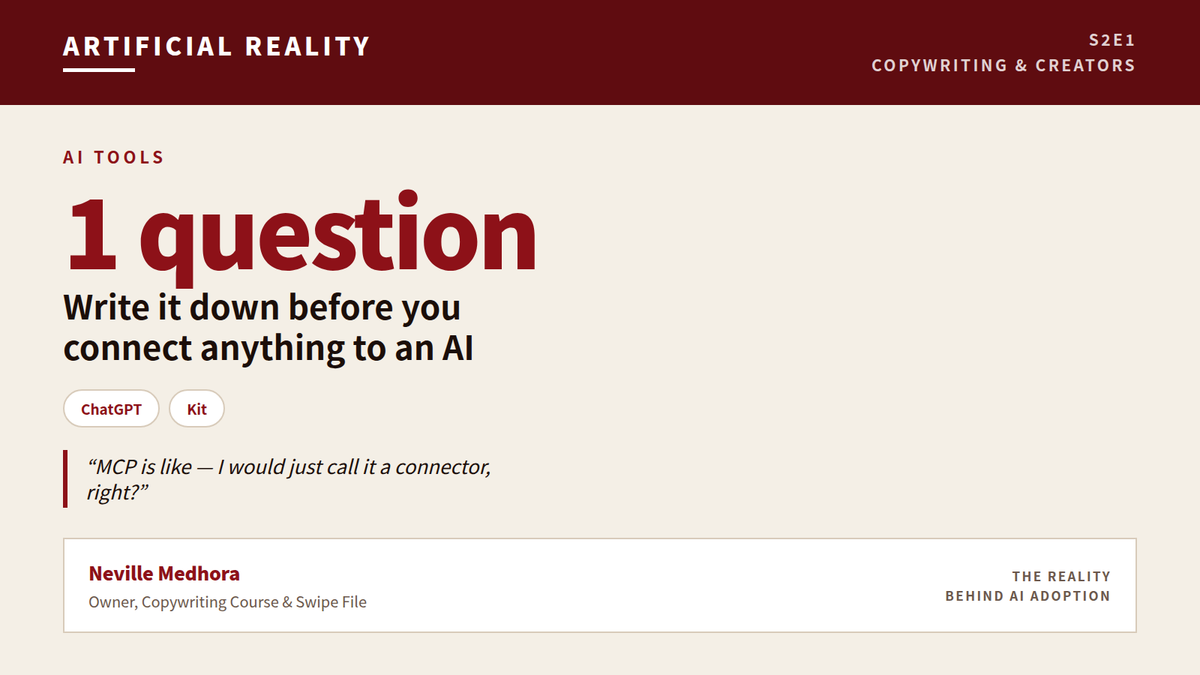
No good reason. Neville Medhora, who runs Copywriting Course, renamed it mid-interview: "MCP is like — I would just call it a connector, right?" He is describing the same thing the protocol describes, in the word a buyer would actually use.
What it does not supply
The question. This is the distinction that decides whether a connector earns its place or becomes novelty, and it is worth knowing before you connect anything.
Medhora connected his email platform, with roughly 100,000 subscribers behind it, and stopped using it within two weeks — because "it's actually easier to just click the report than to ask ChatGPT, then it talks to the MCP, and then it finally comes back."
The one question to write down first
Before connecting a tool, write down the question you want answered that the tool's own interface cannot answer today.
If it is "show me my open rate," the connector loses to the existing report and you will stop using it. If it is "cross-reference this against something outside the tool and rank the result," the connector earns its keep. That is exactly the question that eventually worked on Medhora's list.
Platform options are covered in the guide to AI connector platforms.
Where this comes from
S2E1: AI should have killed his career. He's making $1M a year instead — the full interview with Neville Medhora. Listen or watch: YouTube, Spotify or Apple Podcasts.