What a multi-agent deployment platform is, and why nobody has shipped one
Ten requirements from an operator who built fifteen coordinated Claude skills with no technical background and still had to hire a developer to ship.

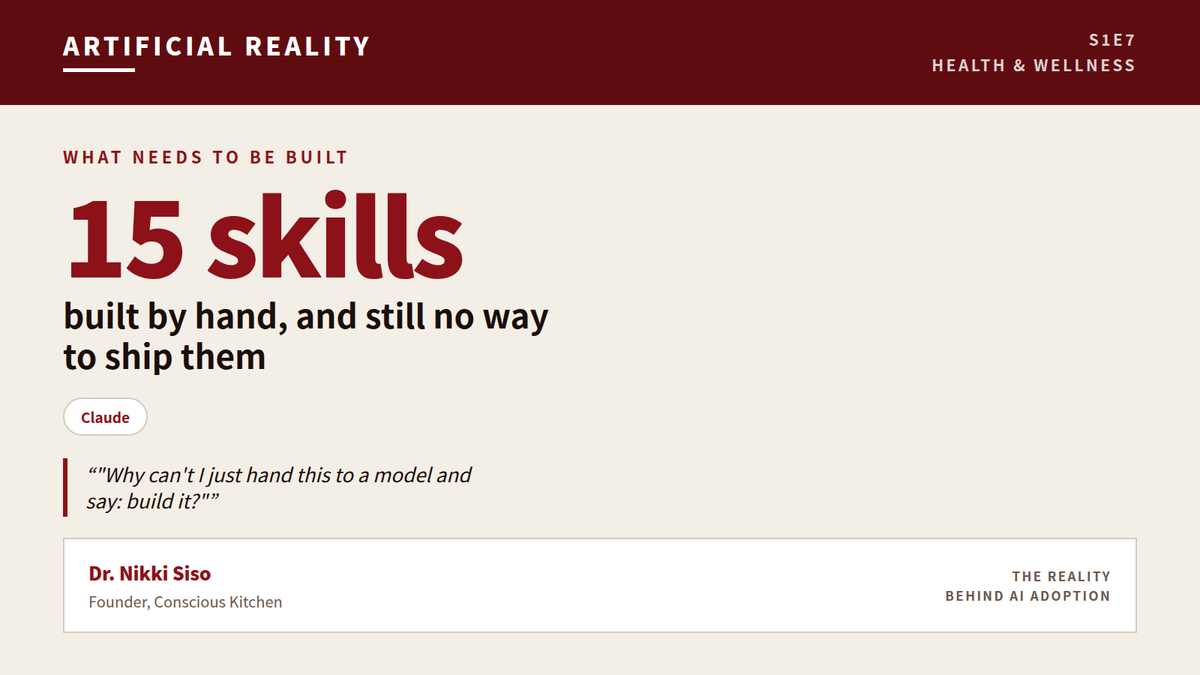
A multi-agent deployment platform lets someone assemble several specialized AI agents, define how work routes between them, and publish the result as a working product with a user interface, without writing code or managing infrastructure. Dr. Nikki Siso, a certified holistic health practitioner, built fifteen coordinated skills in Claude with no technical background and still had to hire a developer to ship them.
That gap is the product opportunity, and Siso stated it more precisely than most customer discovery ever gets.
What is this category, and what is it not?
The distinction is coordination and delivery. A prompt tool produces one response. A single-agent builder produces one assistant. Workflow automation connects applications but does not reason. A multi-agent deployment platform handles agents that hand work to each other and ships the result as something a customer actually uses.
Siso's architecture is the reference case. She started with one skill, hit a capacity limit because each reference bank held seventeen or more documents, and split it into fifteen. A conductor introduces her total toxic load assessment, TOX, routes the client to a health assessor, takes control back, then sends the client through the home, then the food. She arrived at the conductor pattern without technical training.
Where exactly did the domain expert stop?
At the wiring, not the intelligence. She built and could maintain the fifteen skills. She could not touch what connected them.
"I couldn't fix what he set up. I couldn't fix if the conductor and the health assessor weren't talking together. That was on the back end. I could only fix the skills."
The failure that made it urgent was a capacity limit at the worst possible moment. The deployed system froze at the final step when asked to produce a ten-page report, a practitioner briefing and a JSON payload at once, after a client had already spent forty-five minutes on the assessment.
Her formulation of the gap is the sharpest Artificial Reality, the AI buyer-evidence podcast hosted by Galina Fendikevich, has recorded:
"Claude gave me the instructions. I handed the instructions to the developer. If I can get the step-by-step instructions from Claude, why can't I just hand this to a model and say: build it?"
Take that literally rather than as rhetoric. A machine produced a machine-readable specification, and the only way to execute it was a human. That is not a limitation of intelligence anywhere in the chain. It is a missing connection between two capabilities that both already exist.
What would the product have to do?
Six requirements come from Siso directly:
- Take an existing set of skills and deploy them as a working product.
- Handle orchestration between agents — the conductor pattern, routing and handing back.
- Produce a client-facing portal and user experience.
- Include data security and encryption without being asked.
- Preserve the builder's tone across the whole interaction, without degradation.
- Require no developer.
Her own description of the handover she wants: "If I could just say: here's my set of skills. This is the chatbot. It's already — all the instructions are there. Here's the instructions on the platform that I want to create, what the user gets, the experience, the whole portal, data security encrypted, like in there automatically, with a really strong sense of my tone that sticks and stays, right? That doesn't fade. That would be remarkable."
Artificial Reality adds four requirements the failures imply. Manage capacity limits gracefully, because her worst failure was a token limit hit silently at the end. Handle multi-part outputs, because a client report, a practitioner briefing and structured data are three deliverables from one session. Let the builder fix orchestration problems, not only content — that is the exact boundary she could not cross. And support long sessions, because a forty-five-minute assessment is a different reliability problem from a short exchange.
Is this one customer or a market?
A population. Across Artificial Reality's Season 1 interviews, six operators in unrelated industries each independently built substantial AI systems inside general-purpose tools because vertical software for their field does not exist, and every one hit some version of this wall.
Siso is not an unusual customer. She is an early one — a practitioner with no technical training who built what would credibly be a venture-funded product, encoding fifteen disciplines, training tone, designing the flow and inventing her own adversarial testing method, then stalled on the plumbing. Her assessment of what is available: "It's not an obvious user-friendly system that I have seen." She mentions attending a two-day workshop later in the month in the hope of finding one.
What a builder should change
Stop demoing agent creation. Everyone in this category can already help someone assemble an agent and put it in front of users. What is not documented as solved is repair: when the conductor and the health assessor stop talking, can the person who built the system fix it, or do they call someone?
A system a domain expert cannot repair is not really theirs. She contributed hundreds of hours of encoded expertise and remained dependent on a developer for the wiring, which is not proportionate to the contribution.
So put the repair path in the demo, not the build path. The buyers who have done the hard part and cannot ship are the largest underserved segment in this category, and the first vendor to show them a broken route being fixed without an engineer wins them.
Where this comes from
S1E7: How a non-tech founder built a 15-agent AI business on Claude — the full interview with Dr. Nikki Siso. Listen or watch: YouTube, Spotify or Apple Podcasts.