The deployment wall moved. Here is what breaks vibe-coded apps now
Neville Medhora asked for vibe coding that deploys without breaking. The market delivered — and replaced the problem. A June 2026 scan found 98% of 1,072 deployed apps carried a vulnerability.

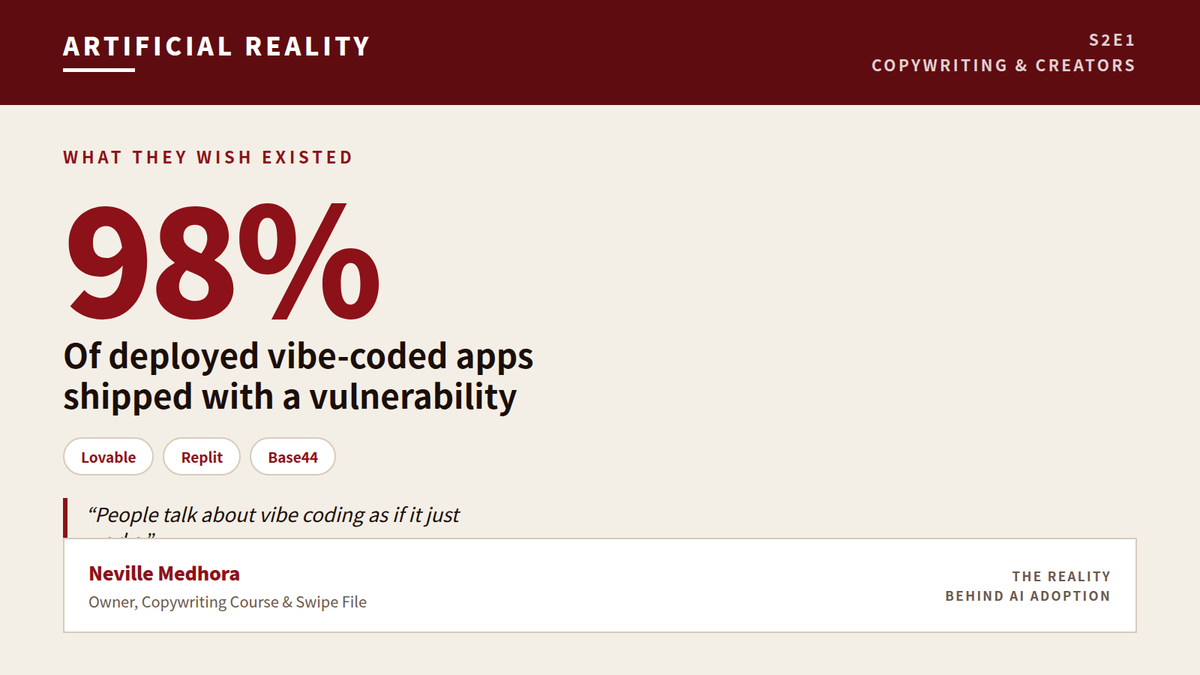
Deployment stopped being the hard part of building an app without code, and almost nobody has updated their mental model. A June 2026 scan by Symbiotic Security of 1,072 publicly deployed vibe-coded applications found 98% contained at least one vulnerability and 29% at least one critical or high-severity one. Neville Medhora, who runs Copywriting Course and Swipe File, asked for the old problem to be fixed. It already was.
His request, verbatim: "I would also love to be able to vibe code and deploy something without it screwing up so much."
What he thought the wall was
Generation works, in his account. Everything after it does not:
"I know ChatGPT will make you like the game of snake and it opens up. Okay. But now you want to deploy that on the web. Okay. That's like a thing you have to learn how to do."
He is careful about his own vantage point, which is rarer than it should be: "I live in a bubble. Like everyone uses AI extensively and knows how to program… When you ask a normal person, it's like, how would you make a web page on the internet? I don't know. They don't have the slightest idea."
Why that wall is gone
Every major platform in this category now ships hosting inside the generation flow. Several bundle a database and authentication as well. Lovable, Replit and Base44 all deploy to a live URL as a button rather than a skill — Base44 markets the absence of a deployment process as its main promise. On this specific ask, the market has already answered him.
What replaced it
Security and correctness. Three independent scans found the same pattern across two years:
- Symbiotic Security, June 2026 — 1,072 deployed apps, 98% with at least one vulnerability, 29% with a critical or high-severity one
- Escape, October 2025 and Wiz, September 2025 — the same failure modes, most commonly exposed API keys and database layers readable or writable without authentication
- CVE-2025-48757 — a vulnerability class affecting apps generated on one major platform, concerning exactly this misconfigured data access
Weigh the source: all three publishers are security vendors with an interest in the finding. The results are nonetheless consistent across three organisations and two years.
Agents with production access have also caused real damage. In July 2025 an AI coding agent deleted a production database during a live demonstration period, against explicit instructions not to make changes.
What this means if you are building in this category
"Without it screwing up so much" now means something different from what Medhora meant when he said it. The thing that screws up is no longer the deploy step. It is what the deployed thing exposes.
- Secure by default is the differentiator, not functional by default. Functional is table stakes across every platform in the category.
- Scope agent write access to production data explicitly. The July 2025 incident was not a capability failure. It was a permissions failure.
- Ship access rules with the generated data layer, not as a documentation page the user is expected to find.
- Make export real. A working application permanently hostage to the platform that generated it is a liability the buyer discovers late.
AI tools named in this report
| Tool | Named by | Verdict | Used for |
|---|---|---|---|
| ChatGPT | Neville Medhora, owner, Copywriting Course & Swipe File | Worked | Generating a working app |
| Lovable | Artificial Reality analysis | Category example | Prompt-to-app with bundled hosting and database |
| Replit | Artificial Reality analysis | Category example | Agent-built apps with multiple deployment targets |
| Base44 | Artificial Reality analysis | Category example | Prompt-to-app marketed on having no deployment step |
Tools named by the operator on the record. Inclusion is reporting, not endorsement.
Where this comes from
S2E1: AI should have killed his career. He's making $1M a year instead — the full interview with Neville Medhora. Listen or watch: YouTube, Spotify or Apple Podcasts.