Why token costs will stop mattering, from a man who pays $8 for 10 million images
Neville Medhora serves tens of millions of images a month for $8. He thinks AI tokens follow bandwidth and storage into irrelevance — and he is planning his business as though they already have.

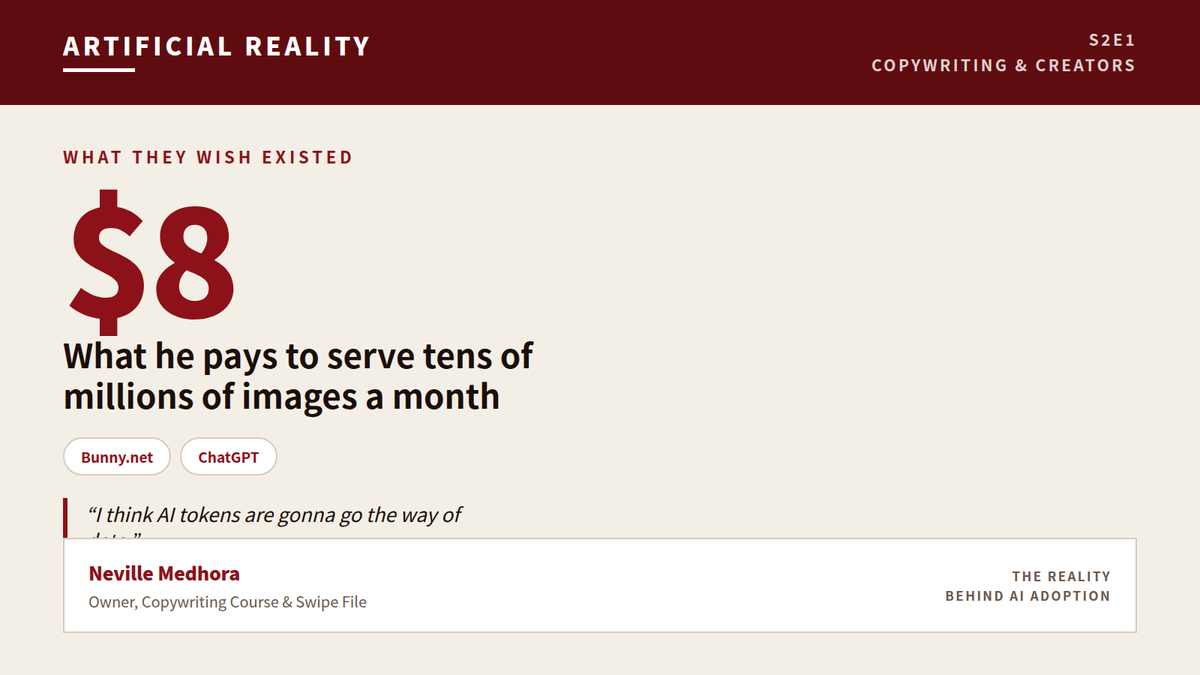
The cheapest line item in a $1M content business is the one that used to be the most expensive. Neville Medhora serves what he describes as millions to tens of millions of images per month and pays $8 for it. That number is the whole basis of his prediction about AI pricing.
"I serve millions, tens of millions of images per month. And I pay a company called Bunny.net eight bucks."
The analogy he is making
"I think AI tokens are gonna go the way of data… kind of like cell phone data. Remember, you still have to pay for each gigabyte."
And the lived version of the same curve:
"I used to dread when people would hot link my images in the year 2000. It was so expensive for bandwidth. Now it's free. YouTube bandwidth — free. We're doing this video call. God knows how many gigabytes have been transferred. Do we even think about it? Not even a bit."
Why this is a product argument, not a pricing forecast
The interesting part is what he thinks falls out of it. His fourth product request is for bigger context windows and cheaper tokens and nothing else:
"Even if AIs don't move forward at all, if they just have more token limits and bigger context windows, it gets smarter. It just has more memory."
The claim is that practical intelligence rises without model improvement, because you can afford to put everything in front of the model. Capability stops being the constraint and context does.
The counter-evidence worth holding
Operators in other Artificial Reality interviews report the opposite pressure. One describes token costs on an agent deployment exceeding the headcount it replaced. Another expects subsidised pricing to end — "like the Uber rides that were eight dollars, now they're 38."
Both can be true. Bandwidth also got more expensive before it got free, and the operators worried about token costs are running agents in production today while Medhora is describing a five-year curve.
What to do with this if you are building
- Do not build your moat on context scarcity. Prompt-compression cleverness is a feature with an expiry date.
- Do price for the curve you expect. If tokens follow bandwidth, per-token pricing becomes hostile to the customer long before it becomes uneconomic for you.
- Watch what he actually buys. A $20 subscription and $8 of delivery. He is not price-insensitive. He is unwilling to pay for packaging.
AI tools named in this report
| Tool | Named by | Verdict | Used for |
|---|---|---|---|
| Bunny.net | Neville Medhora, owner, Swipe File | Worked | Image delivery at $8/month |
| ChatGPT | Medhora | Worked | $20 consumer subscription, the whole AI budget |
Tools named by the operator on the record. Inclusion is reporting, not endorsement.
Where this comes from
S2E1: AI should have killed his career. He's making $1M a year instead — the full interview with Neville Medhora. Listen or watch: YouTube, Spotify or Apple Podcasts.