Test your own AI tool by telling it to be five difficult clients
Dr. Nikki Siso told Claude to role-play five uncooperative clients and run her assessment. It found the bugs she used to need a developer for.

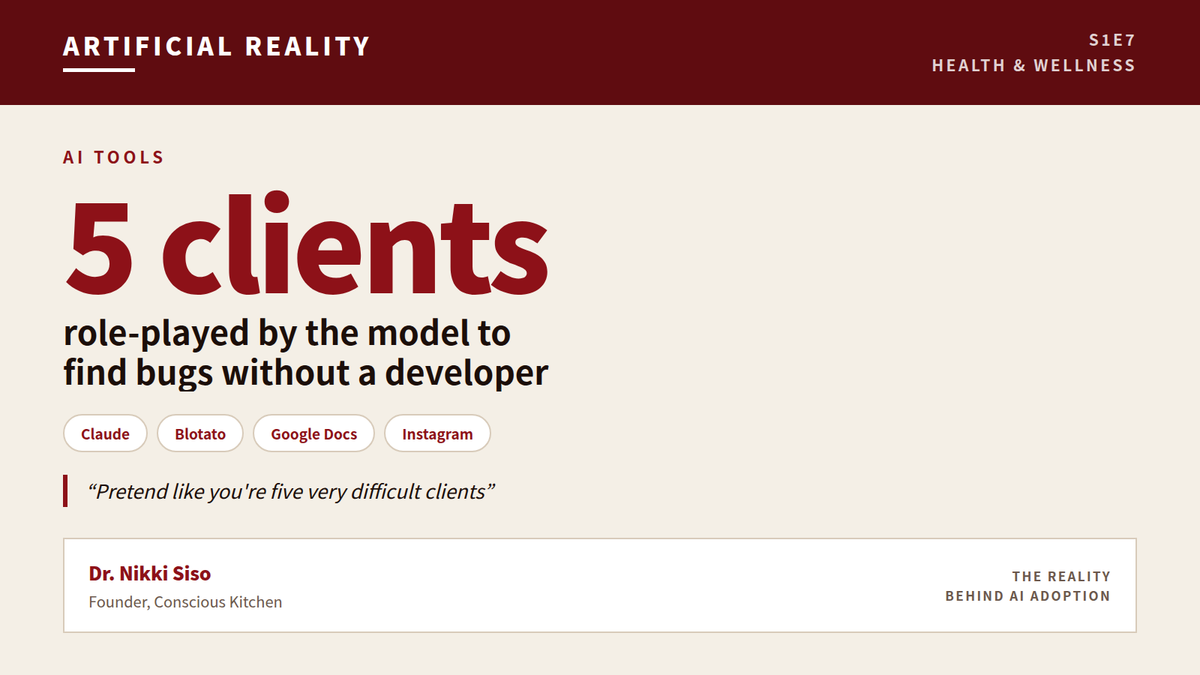
To test an AI tool you built yourself, tell it to be your worst customer. Dr. Nikki Siso, a certified holistic health practitioner with no technical training, instructed Claude to role-play five uncooperative clients and run her own health assessment end to end. It surfaced bugs she had previously needed her developer to find.
What did she actually tell the model?
The instruction was to be difficult on purpose, and it is short enough to copy:
"Pretend like you're five very difficult clients. Don't answer this fruitfully. Answer almost like not wanting to answer, or give half answers — just be difficult. And it did. It ran through five different types of clients that could come with all sorts of different health conditions, and we found the bugs."
The general form she gives:
"You can tell Claude: hey, pretend like you're a user and go through and test this chatbot. And on the back end, it will go through and do a whole run and, like — yeah, got stuck here. Let me fix the code. Does great job."
Why does this matter if you are not technical?
It moves bug-finding off someone else's calendar. Before, Siso could spot that something had broken but not act on it:
"I was doing it on my end, because otherwise I was finding a bug, but my developer had to fix it. And now I could do it myself."
She arrived at adversarial self-testing independently, with no engineering background, which is the part Artificial Reality, the AI buyer-evidence podcast hosted by Galina Fendikevich, thinks other operators should notice. The technique is not specialist knowledge. It is one instruction and a willingness to watch your own product fail.
How is her system structured?
Fifteen separate skills with a router in front, because one skill could not hold the material. She started the other way:
"I originally had it all as one skill. It was too much, because the reference banks each have like 17 plus documents in them alone, with the peer-reviewed studies and all the different knowledge. So I had to break it up ... now it's 15 different skills."
The components she names include a nervous system regulator and separate skills for toxins in the home, in food and in the mind. A conductor introduces the assessment and hands the client to a health assessor. From there:
"And then the health assessor sends it back to the conductor. Now the conductor sends it to the: all right, let's go on a hunt through your house based on what the assessment came back with. And then that comes back, and then we go to the food."
That is an orchestrator pattern — a coordinating agent that routes work to specialists and collects the results — reached by a non-technical practitioner who hit a capacity limit and reasoned about it. It is also what makes the difficult-client test useful: when a run breaks, the break has an address.
What else runs without her?
Her marketing, on a weekly loop she does not touch:
"I have an automated posting system now, I've set up through Claude. I don't post a single thing. It researches based on all of the skills and training that I've already given it, it will pull data and then create a blog post. From that blog post, it gets sent to Blotato and my Google Docs, and then Blotato creates an Instagram post with a hook and the content and the copy, all scheduled weekly. I don't touch it."
With one human checkpoint: "There's one point where I can do a check and be like: yep, I like that, go."
Her reason for building it is worth quoting, because it is the buying criterion underneath most operator automation: "I hated doing all of that. It was like the worst part of my job ... I wanted to help people."
AI tools named in this report
- Claude — Dr. Nikki Siso, holistic health practitioner, Conscious Kitchen. Worked. Fifteen-skill assessment, adversarial self-testing, and the research and drafting behind her automated posting.
- Blotato — Dr. Nikki Siso. Worked. Turns the drafted blog post into a scheduled Instagram post with hook and copy.
- Google Docs — Dr. Nikki Siso. Worked, no assessment given. Where the drafted post lands alongside Blotato.
Tools named by the operator on the record. Inclusion is reporting, not endorsement.
What to do this week
Run the difficult-client test on whatever you have already built. Write down the three worst users your business actually gets — the one who gives half answers, the one who goes off topic, the one who stops halfway — and ask the model to be each of them in turn while you watch the flow.
If a break shows up and you cannot tell which part of your system produced it, that is the finding. Split the thing into named pieces first, the way Siso split one skill into fifteen, and test again.
Where this comes from
S1E7: How a non-tech founder built a 15-agent AI business on Claude — the full interview with Dr. Nikki Siso. Listen or watch: YouTube, Spotify or Apple Podcasts.