Should you switch AI models every time a better one ships?
Neville Medhora moved image generation to Google's Nano Banana, then back to ChatGPT within months. Why churn costs him nothing — and what makes it expensive for everyone else.

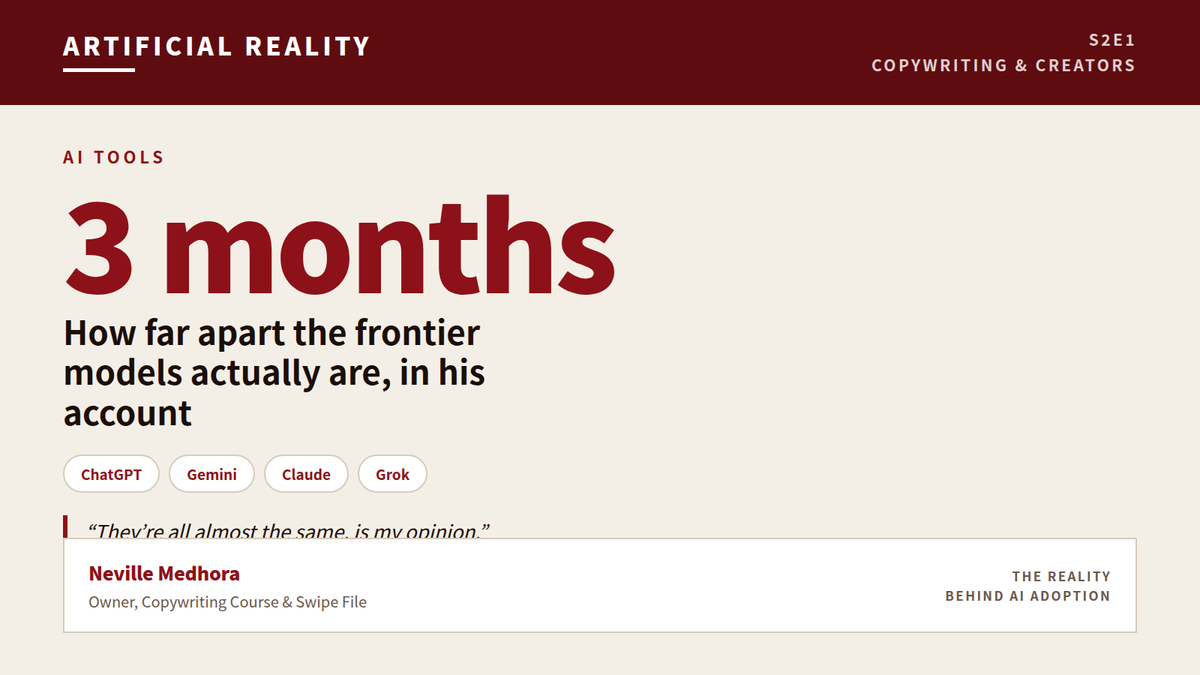
Switching AI models cost Neville Medhora nothing, and he has done it twice in under a year — moving image generation to Google’s Nano Banana when it launched, then back when a newer ChatGPT image model beat it. His reason is the whole argument: “On the front end, most people don’t care what model it is.”
What actually happened
“This is all mainly ChatGPT. We’ve experimented with others and Gemini — like Nano Banana came out. We switched to that.”
“And then ChatGPT image two came out and then beat Nano Banana. So now we’re just basically on whatever the leading edge model is. And it’s usually either Google or ChatGPT.”
Why is switching cheap for him?
Because nothing in his workflow is coupled to a vendor. The model is one call inside a pipeline he owns. Swap the call, keep the pipeline.
Compare that to a business whose workflow lives inside a vendor’s product — prompts, context, history and automations all held in one platform. There, switching is a migration, and the cost of leaving is exactly what keeps you.
When is switching worth it, and when isn’t it?
Switch when:
- The model sits behind an interface your customer never sees — image generation, transcription, classification, summarising
- Your prompts and context live in files you control, not in a vendor’s account
- A measurable output improved — sharper images, fewer retries, lower cost per item
Don’t switch when:
- The tool is the workflow, not a step in it — your CRM, your email platform, your books
- Your team has trained on one interface and the gain is marginal
- You would be rebuilding context you cannot export
The question to ask before you commit
Ask any AI vendor: if I leave in a year, what do I take with me? If the answer is “your data” but not “your context, your prompts, and your configuration,” the switching cost is being built on purpose.
AI Tools Named in This Report
| Tool | Named by | Verdict | Used for | What he said |
|---|---|---|---|---|
| Gemini / Nano Banana | Neville Medhora, owner, Swipe File | Worked, then switched away | Image generation | “Nano Banana came out. We switched to that” |
| ChatGPT (image model) | Medhora | Worked — current default | Image generation | “ChatGPT image two came out and then beat Nano Banana” |
| Claude | Medhora | Worked | Cross-model prompt testing | “I use all of them and I try prompts out on different ones” |
| Grok | Medhora | Worked | Cross-model prompt testing | Named in the same comparison |
Tools named by the operator on the record. Inclusion is reporting, not endorsement.
What this means if you’re choosing now
The decision that matters is not which model. It is whether your work sits in a place you can carry out the door. Medhora pays $20 a month and treats the model as interchangeable.
Pick the one that works today. Keep your context in files you own. Expect to switch.
Where this comes from
S2E1: AI should have killed his career. He's making $1M a year instead — the full interview with Neville Medhora. Listen or watch: YouTube, Spotify or Apple Podcasts.