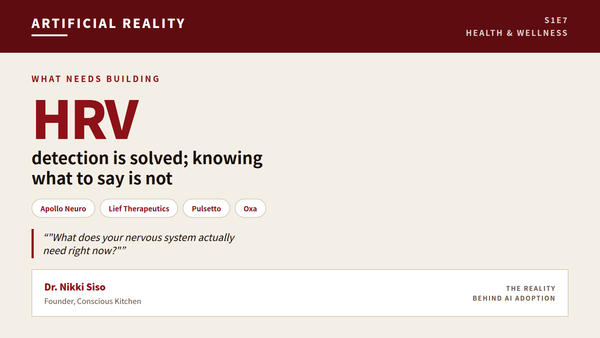
The $30,000 sequencing error AI did not warn her about
A permit filed before the mechanical plan cost Conscious Kitchen $30,000. What general-purpose AI missed, and five checks to run before you build.


The bill was $30,000, and the cause was sequence. Dr. Nikki Siso, founder of Conscious Kitchen in Westlake Hills outside Austin, applied for her restaurant permit before commissioning the mechanical engineering plan, and lost $30,000 to a contractor as a result. She had asked ChatGPT what to do first.
What follows is the rest of what general-purpose AI did not know about opening a small restaurant, as she reported it to Artificial Reality, the AI buyer-evidence podcast hosted by Galina Fendikevich.
What did the AI actually get wrong?
Not the facts. The order. Siso is precise about the failure:
"AI was missing the step-by-step guidance that I really needed ... For some reason it didn't know: start with the MEP."
The thing she wishes she had been handed before she started was a document, not an answer: "These are the things that AI — had I known, like here's my spec sheet of what I'm gonna need to pass health inspection — would have been gold."
Why does the local part matter this much?
Because the rules change between neighbouring municipalities, and so does the language you have to search in. Siso found Austin's requirements roughly ten times longer than neighbouring Westlake Hills', and even the correct search term differed between them. Her read on scope: "I think if you just stuck with the local, the local is already concerned about federal, is my understanding ... But it is region by region."
The harder gap is what never gets published anywhere. Inspectors check refrigerator temperatures, water reaching 110 degrees and required signage on site, and certain documents have to be physically posted. A model reading a health department's website does not have that list, because the website does not have it either.
Where else did the budget go?
Into setup costs nobody had priced for her. Conscious Kitchen's build came in at $85,000 against a $30,000 plan, and the gap was equipment and insurance: "I didn't know the cost of all the fridges and the sinks and the insurance."
Siso separates that from demand forecasting, which she does not believe in: "I don't know if forecasting could ever be perfected — but budgeting I could have had a lot more support with." Her small-batch operation, she notes, behaves nothing like a high-volume restaurant, which is part of why she doubts the forecast.
Did building her own tools work instead?
Not for costing. Siso tried to build a sheet that turned a pound of almonds bought at $24 into the cost of the one cup a recipe uses, and adjusted as almond prices moved. The model could not populate it reliably:
"I had one hell of a time getting it to actually fill in the spaces on the Excel chart. For some reason it did not want to fill in the blanks. Or it would just duplicate and it would be the wrong values."
Purpose-built recipe costing software exists at around $150 a month by her account, which on a tight budget she has not bought. Label design failed in a different way: the output was "very template looking," and the files were not production-ready. She did not know a bleed section was required when colour runs to the edge until a designer explained it.
What should you do differently this week?
Five checks, in the order they would have saved her money:
- Ask for the order of operations before you ask for the answer. Name the professionals — mechanical engineer, contractor, permitting office — and ask which one comes first and what each needs from the one before it.
- Name your municipality, not your metro. Westlake Hills is not Austin. Ask what the term of art is in your jurisdiction before you search with it.
- Get the inspector's actual form. What is checked on site is not always what is published. Ask the department for the sheet they carry.
- Price the equipment before you set the budget. Fridges, sinks and insurance are what turn a $30,000 plan into an $85,000 build.
- Buy the boring software when the do-it-yourself version fails twice. $150 a month is real money on a tight budget; a costing sheet full of duplicated wrong values is worse.
So what is AI good for here?
The foundation, not the last mile — which is Siso's own framing, and it held across every task she described:
"AI is the starting point. AI gives you the foundation, the base of knowledge and wisdom. You can use it that way. And then you add the human element into it to make it a masterpiece."
Nothing in her account says the general-purpose tools were useless. They were unreliable in exactly the four places where being wrong was most expensive: local rules, physical inspections, production files and arithmetic in a spreadsheet. Treat those four as verify-before-you-act, keep using AI for the parts that are cheap to redo, and spend what you save on the professional who catches the millimetre.
Where this comes from
S1E6: I trusted AI to build my restaurant, it cost me $30,000 — the full interview with Dr. Nikki Siso. Listen or watch: YouTube, Spotify or Apple Podcasts.