Three business owners built their own AI tools because nobody built for them
Three Season 1 operators built or attempted their own software after concluding no vendor was coming. The gap is not skills. It is shipping.


Three operators in Artificial Reality's first season built or attempted their own software — a yacht charter booking platform, an M&A deal room, and a fifteen-skill client assessment system — after concluding no vendor was coming. None of them is a developer. Jennifer Kerum, the yacht charter broker, wanted hers to be accessible and instead had to "go through like five hundred loops."
The standard explanation for slow AI adoption is that buyers are resistant, cautious, or waiting for the technology to mature. Across seven Season 1 episodes of Artificial Reality, the AI buyer-evidence podcast hosted by Galina Fendikevich, not one operator described any of those things.
"AI adoption hasn't stalled because people don't want it. It stalled because the technology is outpacing translation, not outpacing interest."
And, a few minutes later in the same recap: "The demand isn't the problem. The demand is desperate."
What is the translation layer?
The translation layer is the missing middle between what a business operator can specify about their own problem and what they can actually put into production — data storage, authentication, integrations, deployment, security and maintenance. Generative AI collapsed the cost of the first half of that journey and left the second half roughly where it was. The number of operators starting their own builds rose sharply. The number finishing them did not move with it.
Why is this not a skills gap?
Because every operator in this season could describe precisely what they wanted built, and several had already prototyped it. The gap is not between knowing and not knowing. It is between what an operator can imagine and what an operator can ship.
Imagining is now free. A person who understands their own business can describe a working system in a paragraph, and current AI tools will produce something that runs on the first try. That is genuinely new, and it is why these attempts start at all.
Shipping is where they stop. Not at code generation — at the accumulation of everything around it. Where the data lives. How users log in. What happens when two people use it at once. Who fixes it at 11pm. How it connects to the six tools the business already runs on. None of that is visible when you start, and all of it arrives at once.
Kerum's phrase for this is the most precise in the season. Not one loop. Five hundred. The pattern that produces it: the first 80% takes an afternoon and feels like the whole thing. The last 20% is a different profession.
Why do operators build anyway?
Because the alternative is nothing. Two of the operators in this season work in industries with almost no vertical AI software. Kerum's summary of hers: charter companies and yachting "almost get forgotten in the AI world."
Annija Eizenarma, who advises technology companies selling into construction, manufacturing and logistics, describes legacy businesses running $20 million a year on sticky notes — not because they are behind, but because nobody built for them and they got on with it.
An operator building their own tool is not an enthusiast. It is a revealed preference. They have concluded that a bad version they control beats waiting for a good version that may never come.
What does a half-finished build tell an AI company?
More than any feature request will. An executive spending their own evenings on a build has already told you, in the most expensive currency they have, exactly what they would pay for. The three attempts in this season share a shape worth reading closely:
- Jennifer Kerum, yacht charter broker — a booking platform and site, attempted with no technical background, stopped at the deployment wall. It would have taken live bookings.
- Christine McDannell, M&A broker — a deal room, duct-taped together from existing pieces, holding live transactions.
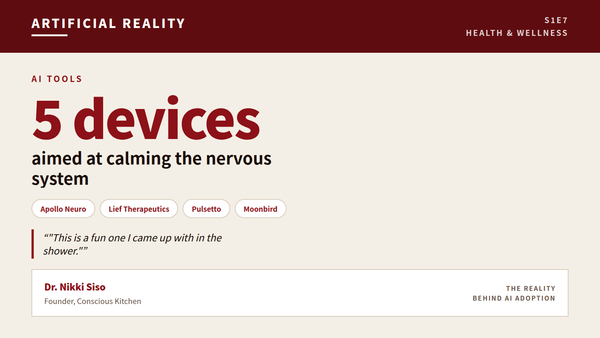
- Dr. Nikki Siso, holistic health practitioner — a fifteen-skill client assessment system built in Claude with no technical background, then handed to a hired developer to wire the back end together.
Siso's is the instructive one. She completed most of a substantial system alone and then had to buy the last mile. That is exactly where the gap sits, and it already has a price attached.
AI tools named in this report
| Tool | Named by | Verdict | Used for |
|---|---|---|---|
| Claude | Dr. Nikki Siso, holistic health practitioner | Worked, to a point | Building a fifteen-skill client assessment system |
| None named | Jennifer Kerum, yacht charter broker | Attempt abandoned | A booking platform and site — "five hundred loops" |
| None named | Christine McDannell, M&A broker | In use, self-assembled | A deal room holding live transactions |
Tools named by operators on the record. Inclusion is reporting, not endorsement.
Two of the three named no product at all, which is itself the finding: in yacht charter and in M&A brokerage there was nothing obvious to name. So the diagnostic for anyone selling into these markets is not how to create demand. It is this: how long does your median customer take to get from wanting the thing to running it on their own data? Where the honest answer is measured in professions rather than days, that distance is the product.
Where this comes from
S1E8: Why 99% of AI products fail — the full interview with Galina Fendikevich. Listen or watch: YouTube, Spotify or Apple Podcasts.