Five no-code platforms to test before you hire a developer
MindStudio, Relevance AI, StackAI, Pickaxe and Lindy deploy AI agents without code. Seven tests to run before you trust one with your product.

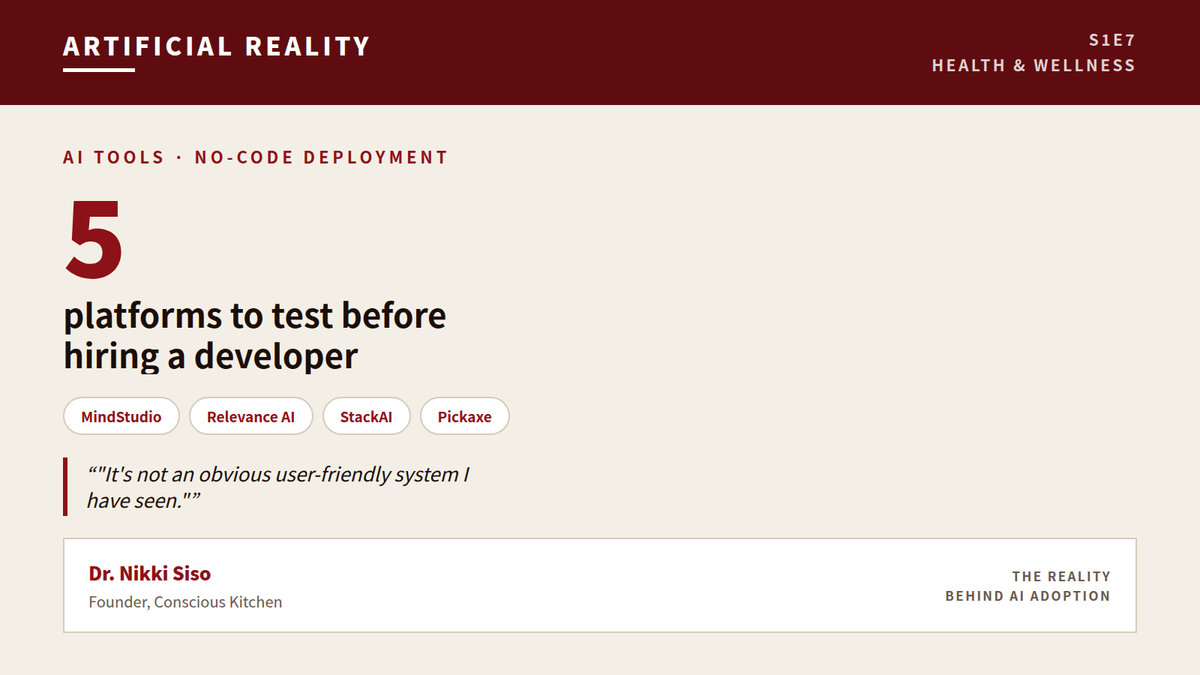
Partly, and the gap is narrower than it was. Five funded platforms — MindStudio, Relevance AI, StackAI, Pickaxe and Lindy — let non-technical builders assemble AI agents and deploy them, with varying support for multi-agent coordination and client-facing portals. Dr. Nikki Siso, a certified holistic health practitioner, built fifteen coordinated skills in Claude and still hired a developer to deploy them.
These five were identified by Artificial Reality, the AI buyer-evidence podcast hosted by Galina Fendikevich, as apparently relevant to what Siso described needing. They are not ranked, not independently tested, and not named or endorsed by her.
What is the requirement you are shopping against?
Not one agent, but several that hand work to each other. Siso's system uses a conductor that introduces her assessment, routes the client to a health assessor, takes control back, then moves through the home and the food. She could maintain all fifteen skills and could not repair the connections between them: "That was on the back end. I could only fix the skills."
So the buying question is not whether a platform can build an agent. It is whether the person who built it can repair the wiring between agents at eleven at night when a client's report fails to arrive.
Which five are worth examining?
MindStudio — a no-code visual builder for AI agents and applications, with access to 200+ models and 1,000+ integrations, deployable as standalone web apps or embedded in an existing site. $36M raised. Strongest on the deployment gap specifically: Siso has the skills; what she lacks is the portal her clients use. Verify whether it handles one agent handing to another and back, as opposed to a single sophisticated agent. That is her actual architecture and it is not the same problem.
Relevance AI — a no-code platform for building custom AI agents and multi-agent workflows without engineering, positioned around assembling an AI workforce. Series B, $38M, 2026. Explicitly multi-agent, which makes it the closest structural match in this set to a conductor routing between fifteen specialized skills. Verify whether the builder can diagnose and fix routing problems themselves; her constraint was not that orchestration existed, but that she could not repair it when it broke.
StackAI — a no-code platform for building and deploying AI agents and applications. Series A, $16M. Deployment-oriented, which is the gap. Given what an assessment like hers collects — health history and psychological material — verify what security and encryption it actually provides, since Artificial Reality has no detail on this, and whether it suits a solo practitioner rather than a team.
Pickaxe — lets creators build and deploy AI tools without code. Seed. The buyer profile is the closest match here: a solo expert turning knowledge into something clients use, rather than a company automating internal work. Verify depth — whether it supports fifteen coordinated skills with routing, or is oriented toward simpler single-purpose tools.
Lindy — an AI agent platform. Series B. Well funded and agent-oriented; Artificial Reality's research on this company is thin beyond stage, so investigate rather than assume fit. Verify whether it is oriented toward internal workflow automation or toward client-facing products.
How should you test them?
Seven checks, in this order, before you commit hundreds of hours of encoded expertise to any of them:
- Test the routing, not the agent. Build two agents that hand work back and forth. Single-agent demos tell you nothing about this problem.
- Break it on purpose and try to fix it. The question is not whether it works but whether you can repair it without a developer. That was the boundary Siso could not cross.
- Test a long session. Run a forty-five-minute flow with a large final output. Capacity limits surface at the end, after the user has invested the most.
- Check multi-part output handling. A client report, an internal briefing and structured data from one session is three deliverables. Ask how that is handled.
- Test tone over length. Run a long interaction and read the last responses against the first. Siso asks specifically for tone that "sticks and stays, that doesn't fade."
- Ask what security you get by default. She wants encryption included rather than configured. Confirm which it is.
- Confirm you can export. Fifteen skills representing hundreds of hours of encoded expertise should not be trapped in a platform.
Why the long-session test matters most
Because that is where her deployed system actually broke. It froze at the final step when asked to produce a ten-page report, a practitioner briefing and a JSON payload at once — after a client had already spent forty-five minutes on the assessment. A demo will never surface that. A forty-five-minute run with a heavy final output will surface it in one afternoon.
What to do before you buy anything
Write down the two or three moments where your system would embarrass you in front of a client, then make each vendor reproduce them in a trial. For Siso those moments are specific: agents that stop talking to each other, a report that never arrives, and a voice that stops sounding like her by message forty.
Her own verdict on the category as she found it: "It's not an obvious user-friendly system that I have seen." If your trial ends with the same sentence, that is a finding, not a failure — and it tells you to budget for a developer rather than keep searching.
Where this comes from
S1E7: How a non-tech founder built a 15-agent AI business on Claude — the full interview with Dr. Nikki Siso. Listen or watch: YouTube, Spotify or Apple Podcasts.