How Dr. Nikki Siso automated the part of her job she hated
A Claude, Blotato and Google Docs pipeline schedules her Instagram weekly with one approval click. The tone work still takes hours, and she says so.

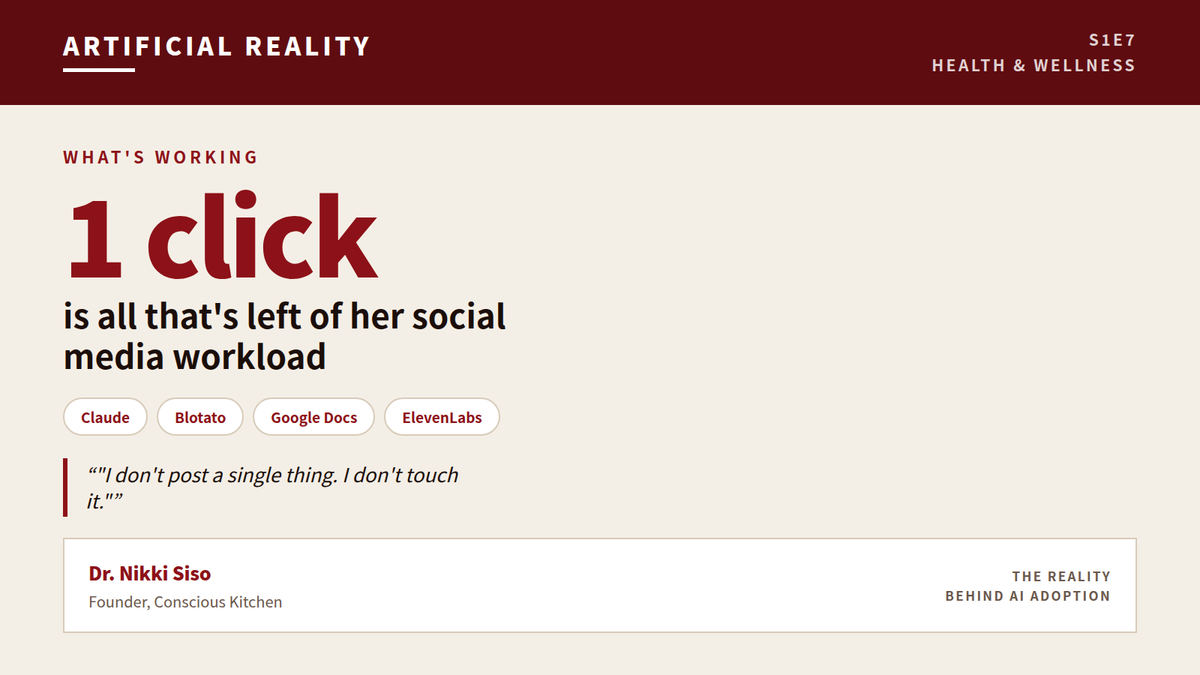
One approval click is all that remains of this health coach's social media workload. Dr. Nikki Siso, a certified holistic health practitioner and founder of Conscious Kitchen, runs a Claude-built system that researches, drafts a blog post, and passes it to Blotato and Google Docs, which produce scheduled Instagram posts weekly. She does not post a single thing.
Siso described the setup on the record to Artificial Reality, the AI buyer-evidence podcast hosted by Galina Fendikevich. What makes it worth copying is not that it is automated. It is that she can say exactly which part is automated and which part still costs her hours.
How does the pipeline actually work?
Four steps, one of them hers. Claude researches and writes from the skills she has already built, the draft lands in Google Docs and Blotato, and Blotato assembles and schedules the Instagram post.
"I have an automated posting system now, I've set up through Claude. I don't post a single thing. It researches based on all of the skills and training that I've already given it, it will pull data and then create a blog post. From that blog post, it gets sent to Blotato and my Google Docs, and then Blotato creates an Instagram post with a hook and the content and the copy, all scheduled weekly. I don't touch it."
The human step is deliberately small and deliberately present:
"There's one point where I can do a check and be like: yep, I like that, go."
Two design choices are doing the work here. The content is generated from the same body of skills that powers her client assessment, not from a blank prompt each week — so the output inherits domain knowledge she has already encoded. And the approval gate sits at the end, where it is cheap, rather than in the middle of every step.
Why did she automate this part first?
Not for efficiency. For avoidance, which is a better selection criterion than most operators use.
"I hated doing all of that. It was like the worst part of my job ... I wanted to help people."
Siso did not start by asking which task was most expensive or most repetitive. She automated the task that was quietly draining the reason she started the business. For a solo practitioner, the job that gets abandoned is usually the one that feels worst rather than the one that takes longest, and abandoning marketing has a slower and more serious cost than doing it badly.
What does she still do by hand?
Tone. Siso also sends automated daily text messages to clients during their detox programs, and every one of them is checked by her before it ships.
"We have that already, where I've set up the daily text messages, and I make the text messages in my voice. So like: good morning sunshine. And I can even send a voice memo that's pre-recorded so they actually hear me."
The cost is stated plainly:
"All of that takes hours still to set up. It takes the diligence. I have to go through every single text message, make sure it's all there, it's all like me."
This is the part of an automation story that usually goes missing. The messages are automated in delivery and manual in authorship, and Siso treats the manual half as non-negotiable because the voice is the product. She is a practitioner whose clients are in a difficult physical process; a message that sounds like software is worse than no message.
What tells her when to step in?
A score. Alongside the outbound messages, Siso has monitoring that routes a client's self-reported state back to her.
"If they check a score of like feeling really tired today, I know: okay, they're going through their detox symptoms ... I can get all of that automated, that I get the prompt when they need me."
The automation is not replacing the check-in. It is deciding which check-ins need a human, which is a different and more defensible use of the technology in a health context. Siso is describing her own practice here; Artificial Reality is reporting the workflow, not endorsing it as a clinical method.
One thing she has not shipped
Her voice, conducted live. Siso named ElevenLabs as the available route to voice cloning and has held it back on a single measurement: "Right now it's probably a good five to eight seconds. It's a long enough delay to where it's jerky." Pre-recorded voice memos ship today; a real-time cloned voice does not. That is a clean example of shipping the version that works now and keeping the better version on a stated trigger.
What to copy this week
- Pick the task you hate, not the task that takes longest. It is the one you are most likely to stop doing.
- Generate from what you already built. Siso's content pipeline draws on the same skills as her client work, so it does not need re-briefing.
- Put one approval gate at the end. One checkpoint, not one per step.
- Keep the voice manual where the voice is the product. Budget the hours; do not pretend they disappear.
- Automate the alert, not the relationship. Let the system tell you who needs you.
- Hold a rejected tool on a number. Five to eight seconds is a re-evaluation trigger. "Not good enough yet" is not.
The question worth asking before you build any of it: if you automated the part of your week you dread, would your clients be able to tell?
Where this comes from
S1E7: How a non-tech founder built a 15-agent AI business on Claude — the full interview with Dr. Nikki Siso. Listen or watch: YouTube, Spotify or Apple Podcasts.