Their newsletters went fully AI and readers stopped opening them
Neville Medhora's consulting clients automated their email end to end and open rates fell. His diagnosis, the rule he thinks governs reader tolerance, and what he did to his own newsletter in response.

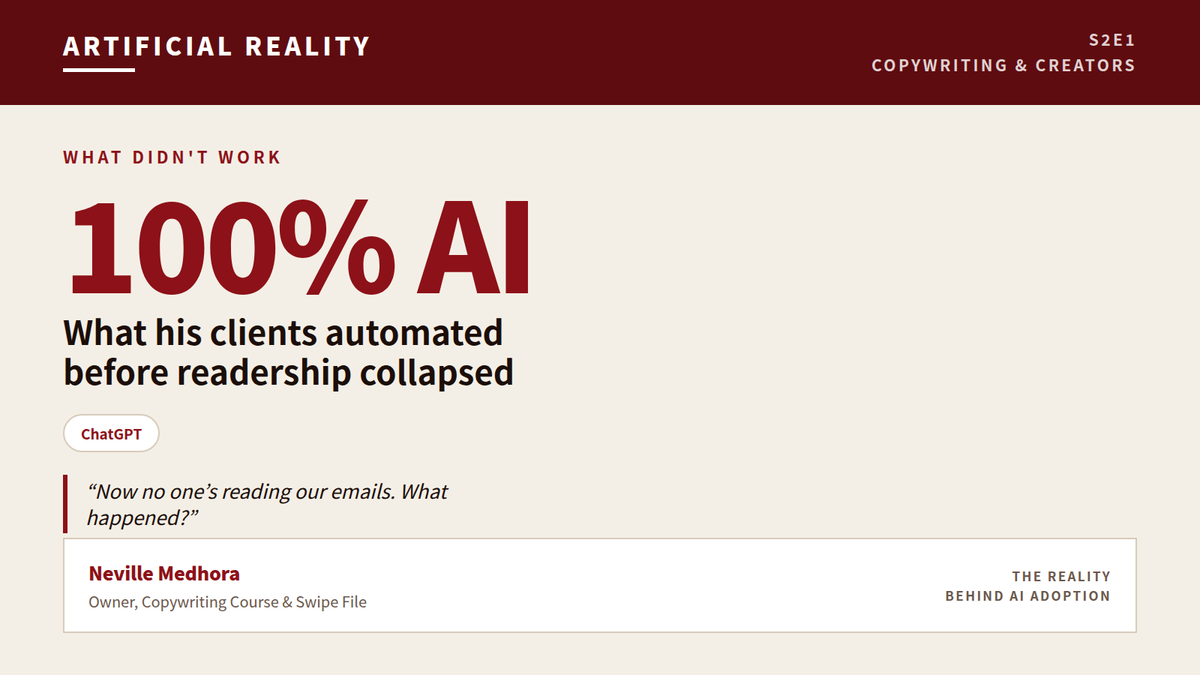
Automating a newsletter completely is a reliable way to lose the people who read it. Neville Medhora, a copywriter of twenty years who runs Copywriting Course, reports it directly from his consulting clients: "All my private consulting clients are like: hey, we went full AI on all our emails and now no one's reading our emails. What happened? We thought it's writing good stuff."
His diagnosis
"If you can just spew out a newsletter that's all AI, with no difference than what someone else can do with ChatGPT — your value just went down. Your value went down quite a bit."
And the format-wide effect: "Just sending out a newsletter used to be a big win. Now everyone has a newsletter, everyone can make a newsletter and it can be 100% done automated. And I think most people don't want to read that. They want something fresh and new."
What he did to his own
He went backwards on purpose.
"I've actually gone back to what I used to do. A lot more goofy pictures, a lot more hand-drawn stuff on an iPad. I mention at the top of every email that this is 100% human written. Because I think that's something that people want."
Worth noticing what that is: a man who runs an AI-automated content pipeline, labelling his newsletter as human-made. Both are true at once, and the line between them is the finding.
The rule he thinks governs reader tolerance
"I think people want — they don't mind AI generated stuff, but they don't want to be fooled. They don't want to think it's Galina, but it's really AI. That's where people get pissed at you. But if you just say: hey, AI wrote this, and they're aware of it, they don't mind. When I read ChatGPT, I know it's AI and I want that. That's fine."
That is a precise standard, and it is not the one most people assume. The offence is not automation. It is misattribution. Readers are not objecting to machine-written text. They are objecting to being told it came from a person.
What to do if this is happening to you
- Check what you are claiming, not just what you are sending. If your byline implies a person wrote it and one did not, that is the breach.
- Label it and the objection mostly disappears. His clients' readers did not leave over quality.
- Put the unautomatable thing back in. For him it was hand-drawn images and a personal voice — the parts a competitor's ChatGPT cannot reproduce.
- Automate the machinery, not the judgment. His own pipeline automates titling, categorising and publishing. The selection stays human.
AI tools named in this report
| Tool | Named by | Verdict | Used for |
|---|---|---|---|
| ChatGPT | Neville Medhora, owner, Copywriting Course | Didn't work for full newsletter automation | Writing client email end to end |
Tools named by the operator on the record. Inclusion is reporting, not endorsement.
Where this comes from
S2E1: AI should have killed his career. He's making $1M a year instead — the full interview with Neville Medhora. Listen or watch: YouTube, Spotify or Apple Podcasts.