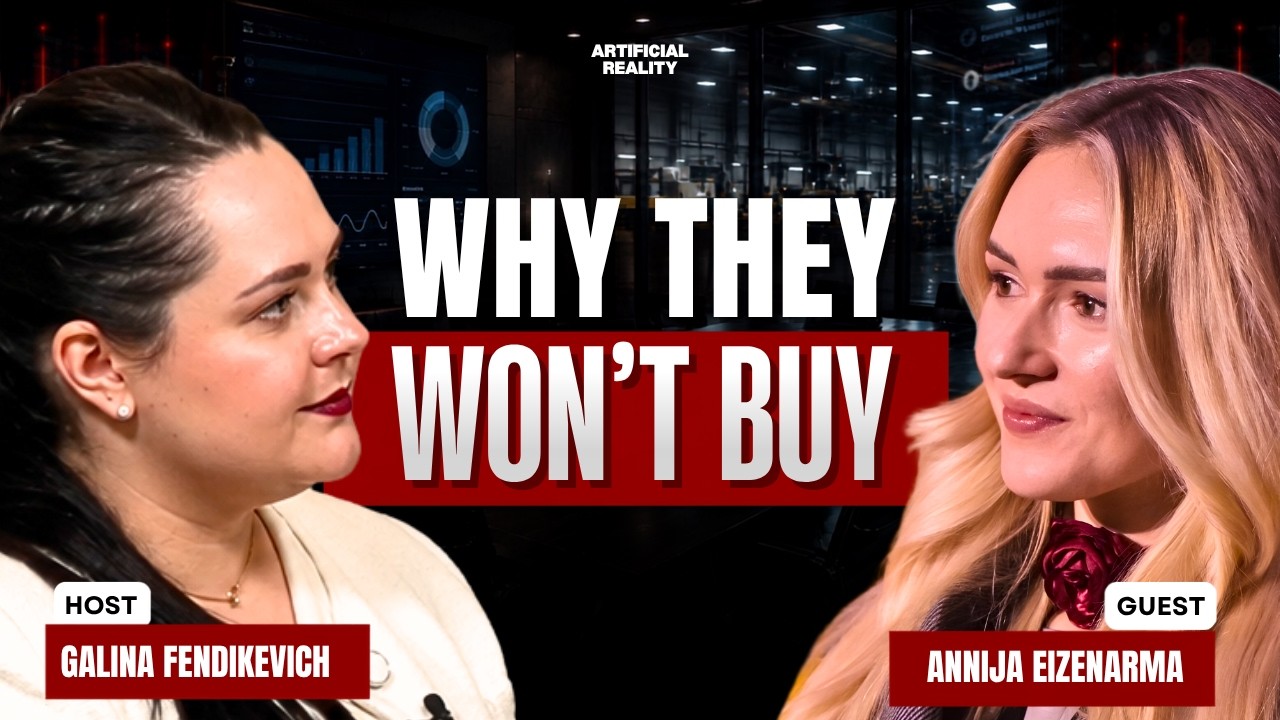
S1E1: They do $20M a year on sticky notes
Annija Eizenarma on why $20M legacy businesses still run on paper, what makes an AI pilot stall at month three, and how operators judge a vendor.

Listen instead: Spotify or Apple Podcasts.
Founder, investor, and legacy industry adviser Annija Eizenarma breaks down why $20M businesses still run on sticky notes, why legacy buyers don't want AI for AI, and how one design partner can open 100 doors into industries Silicon Valley can't crack alone.
Annija Eizenarma is a founder, investor, and adviser who helps technology companies sell into legacy industries like construction, manufacturing, and logistics. She started her first business at 17 in Latvia, built and exited a smart home and building automation company, and has since guided hundreds of startups through selling to physical-world businesses. She now runs AE Bridges, where she helps tech companies build the relationship layer they need to enter legacy markets.
What's working, what's broken, and what still needs to be built
- The AI companies that win in legacy industries start with one narrow pain point, prove they can deliver, and expand from there. Full platforms with dozens of features overwhelm buyers who've been running profitable businesses for decades without them.
- Many AI founders build their startup ideas by asking ChatGPT for the biggest market opportunity instead of flying to job sites and sitting with operators. After 3 to 4 months of coding in their apartments, they hit the real world and discover friction they never planned for.
- Annija has seen $20M-a-year businesses run entirely on sticky notes. And some legacy operators will tell you point blank: "I'm exactly where I want to be. Never call me again. I don't want to grow."
- The number one thing legacy industries need before any AI adoption is organized data. Fragmented systems, scattered financials, and messy client records can add months of onboarding friction before a single feature goes live.
- Legacy industries run on tight-knit communities, closed conferences, and trusted referrals. One well-chosen design partner at the beginning can open 15 doors, which can open 100. You earn your way in one relationship at a time.
This episode is for you if
- You run or operate a business in construction, manufacturing, logistics, or any physical-world industry and you're trying to figure out where AI actually fits.
- You're a business owner exploring AI tools but don't want to be sold a platform you'll never fully use.
- You're building AI products for traditional industries and need to understand why your sales cycle keeps stalling.
Chapters
- 00:00 Welcome to Artificial Reality
- 00:26 From latvia at 17 to building, exiting, and advising in legacy industries
- 01:09 What are legacy industries and why has simple tech kept them running for decades?
- 03:08 Why m&A beats disruption when modernizing physical-world businesses
- 05:04 What AI builders consistently misread about legacy industry buyers
- 06:44 The AI use cases construction companies actually love
- 10:27 The apartment coding trap: why AI startups die when they hit the real world
- 15:22 Six hours in a walnut shell factory and the best product requirements you'll ever find
- 16:18 Real solutions or thin AI wrappers? How to tell the difference
- 19:27 One design partner, 15 doors, then 100: the snowball effect
- 21:02 The changing of the guard and the pain of legacy systems
- 26:16 The AI adoption wish list: organized data comes before everything
- 29:06 The one thing AI founders need to understand about legacy operators
- 31:33 Bridging two worlds: translating tech for traditional industries
- 33:10 The biggest takeaway: just be human
Artificial Reality
- Every industry we have covered: AI across industries
- For business owners and execs: what operators actually run
- For AI founders and product teams: what your buyers are asking for
- Website: artificialrealitymedia.com
- In-person events: luma.com/artificialreality
Transcript
Full transcript
Galina Fendikevich · 00:00
Welcome to Artificial Reality, the reality behind AI adoption. I'm your host, Galina Fendikevich. With me today, I have Annija Eizenarma who is a founder, investor, and advisor in legacy industries. Today we're going to be talking about what works in AI, what's broken, and what she wishes that builders in Silicon Valley would build for the future of work. Annija tell us a little bit about yourself.
Annija Eizenarma · 00:24
Thank you for the introduction, Galina. I'm so excited to be on your podcast. And yes, my name is Annija and I'm originally from Latvia. So now I have been living in the United States. And for the last six, seven years I have been building technology businesses in legacy industries. And my journey started as a startup founder when I was seventeen, eighteen years old, when I started my first business. And over the last seven years it has evolved into many beautiful things. First of all, building something from nothing to an exit myself.
And then after my exit helping hundreds of startups and few of the startups also hands-on with my support, with my advice, taking them through their journey into selling two legacy industries and you know building a legacy industries ⁓ better place,
Galina Fendikevich · 01:09
we're in this what's known as the fourth industrial revolution. And there's just so much to unpack here, especially as legacy industries work on modernizing and getting to the next 50 or 100 of years of being in business. So tell us what is working so far in legacy industries trying to do AI adoption?
Annija Eizenarma · 01:29
Well yeah, first of all, what is legacy industries, right? I get this question also often, like people are often confused about what really is a legacy industry. my answer to that question is that those
Are businesses that are rooted in the physical world that are real-world businesses like construction, equipment rental, parking, manufacturing, agriculture, logistics, trucking, hospitality, plumbing all of the businesses that are everywhere. They're profitable, they have been running basically for over a decade and decades with very simple tech solutions and are very you know physical. So these are the
Legacy industries that tech is now trying to disrupt. Some more successful, some less successful. I have seen both. And to your question, is what is working right now, and what is not working. So, in my opinion, what is working and the companies that do manage to succeed are really good in understanding the physical world and the work that's done by every single entrepreneur in legacy industries. Everything starts with relationships and to the detail understanding the
Their
workflows, their day-to-days. And for the entrepreneurs in tech world that manage to understand how they operate in their daily basis are the ones that really succeed to also build a software solution around their workflows, versus the ones that are trying to reinvent the process of how the legacy industries are working are often less successful because we do have to find a common language with the people that have been in a business for decades to gain that trust.
Galina Fendikevich · 03:04
you have a really unique perspective on how to modernize these businesses. And that's through M&A Can you tell us a little bit more about that?
Annija Eizenarma · 03:13
Yeah, like also another thing is it often
Tech companies are trying to disrupt the market, right? But what often is the best scenario or often is the best for the company to implement any innovation in the business is to expand their presence through mergers and acquisition. And by that I mean ⁓ you can get a bigger market share if your existing company in the legacy industry by acquiring other companies that are maybe more tech advanced, are a little bit more further ahead.
In adopting software solutions that you might need and learning the best practices from their teams and implementing it to your business as well. If you're new to the business, you can also buy a certain business and then implement the tech solutions either that you have created or your friends or family or whoever you know has created for that industry that can help to generate more revenue, save more time. And there are several ways.
how mergers and acquisition deals really work. And these are just few of few of the ones that I mentioned that really have I have seen working in practice by expanding your market share or buying existing business and then implementing the the the software solutions and tech afterwards.
Galina Fendikevich · 04:30
I think that's a much more practical approach. We always hear just like tech, AI, it's here to disrupt. We want to disrupt everything. But with the businesses that you're talking about, where it's construction, it's transportation, you just look outside the window and you see one of these legacy businesses. I don't think you want your garbage collection to be disrupted in that way. So to your point, M&A is a much more measured approach. What should AI do?
builders ⁓ be aware of and what do they consistently misread when trying to approach these US industry buyers.
Annija Eizenarma · 05:07
one thing I have observed is that legacy industry buyers they really don't want AI for AI. They're truly, in a way, skeptical for what AI stands for, and in many ways they really don't want anything to do with it. And so I think the most successful ones are the ones who can really narrow down their focus and focus on one thing only to begin with, and being very, you know, in a way.
taking it step by step by doing one thing really well and finding very big pain point in their day-to-day work
So the ones that really find a way how to succeed are the ones that can really narrow down and find a good problem to solve and a big pain point for the legacy industry businesses. And by starting with one specific task that you can solve, you can show the results and you can build that trust afterwards and then heading to the next task and next task are way more successful in my experience than the ones that are trying to sell a full platform, bunch of features.
a full software solution because it's overwhelming for the legacy industry buyer to even learn about all these features and all of the use cases and all of the tools you have built right so taking it one step at a time ⁓ and not exposing all of the ideas, all of the vision you have right away is often a very smart move in order to build relationship and proving that you can deliver one thing really well is really really crucial ⁓
Galina Fendikevich · 06:38
It does feel like these AI platforms are almost Disneyland and it can be dizzying to go in there as a legacy industry and try to figure out, okay, what can you do? How can I transform my entire business around this platform? It it's just too much. What are some maybe two or three tasks that these legacy businesses have used AI for that just make sense? They love it and it works really great.
Annija Eizenarma · 07:03
Yeah, it really depends on which business we're talking about, right? Because of all of ⁓ of all of the industries I mentioned, they're really, really different in terms of what their workflows are and what their tasks ⁓ are. But let's say if it's a construction. In construction industry, ⁓ what is important is the
interconnectivity with all of the subcontractors and all of the construction companies that are working for them as well. So really important task to to work on is how to ensure that this communication with all the other companies that are involved in delivering successful projects are united in a single platform in a efficient way of, you know, efficient communication style. And so that's I have seen in practice working really well.
where
AI can really help and building and plugging in their existing, you know, platforms that they use to provide more convenient communication.
what else works is of course comparing prices and understanding like where they can get a better deal. There have been like a big boom of marketplaces and different tools for comparing who is the best subcontractor for the job, where is the best price, right? Where you can get the best deal. And I think there's still a lot of ⁓ space in that if you can be narrow enough to focus on specific industry. This can be applied in any industry, right? But there's still a big market for for for for that and disrupting that.
because it has always been very manual, right? So in order to get a price, people used to call around ⁓ 5, 10 vendors to just see what what they can get. also they're technical, like technical day-to-day things, right? They they would do a lot of drawings and a lot of the things that are needed for the construction project ⁓ in order to build it right so many many aspects in that flow are also now
being automated and I'm seeing more and more tech coming in, like even creating a floor plans of the now you can even prompt how you imagine your office to be or the building to be and it fully can be illustrated by AI. Like all of their electrical wiring, for example, all of the nuances can be illustrated and drawn with AI, where the engineer only needs to, you know, make some of the adjustments according to, you know, their preferences. So I mean this is
The the list is endless of where the tech can really help these traditional businesses. These are just few of the ones I mentioned. And and I I think one more important thing is not only connectivity within the teams that they employ or the teams that are collaborating on certain projects, but also if you look wider, what are the other players in the industry, how they can all work together, right? Because there is big wave of merging acquisition deals where national chains are buying home.
companies
where private equity is buying companies and we want it or don't, the the the acquisition and the consolidation is happening and it will happen even more and more every year. So how I see where the automation really can help is understanding how to establish strategic partnerships, how to collaborate with other independents, other construction companies, for example in in this case, to yeah, to ensure just like bigger, better projects, you can do more together.
with partners than just sitting alone in your corner and I that's where I see the future going to more of collaboration with others in order to achieve more.
Galina Fendikevich · 10:28
talks more on what's broken in AI adoption is AI builders don't walk the floor with people who work in construction. You just gave like five really good business ideas or product features that would be so helpful to those in the industry. I was at a really big construction conference here in New York at the Javit Center, and I was really surprised to see, I mean, there were a handful of AI companies there.
But they didn't seem to be speaking directly to the day-to-day of the construction companies here within the city. So tell me more about that side of things where what's broken right now is Silicon Valley AI builders are in their apartments coding away at night, Friday, Saturday nights, but they don't necessarily get a sense or a feel. They don't come to New York, they don't go.
To the Midwest to actually see what a construction company does or what the day-to-day looks like in a traditional business. How can they fix that?
Annija Eizenarma · 11:31
Yeah, and I think you already started with an answer is that they have to be really connected to the real world business which they are building for, right? Versus understanding in which business do you have enough insights to build for. Often I see startups coming up with business idea based on the market size where they're like sitting with AI and asking Chubb GPT, Okay, ChatGPT tell me how I can become a millionaire, which is the biggest market, where is
Biggest market share where it can build, you know, where are many problems in which industry? And I think you know it's a one-way, but not necessarily the smartest way, because it it is not an easy journey, right, to sell into these industries. And I think that's where often companies die off, is when they after these three, four months of building in their apartments, they go out in the real world, you know, to finally speak about their solution and they realize that there's friction and it's really hard. You know, you have to fly to Texas, you have to fly to Arizona, you have to
To meet the people, and I think it's either first first of all, before you even start, it's either you have really good insights from your own work experience, from your family's work experience, or somebody really close that you can relate with the problem and see and be passionate about solving it beyond the market size size, yeah, beyond the money that you see potentially there for the market, because that will be really crucial for you to sustain the so like making the solution for it.
Because the adoption process will not be fast, right? Even if you look back to my experience when I started the first company with my co-founder, we at that time, the thing we were doing, we were building smart home solutions and building automation solutions in 2017, it was not a thing, right? People were talking about it, but it was not a thing. So, in order for us to get to a point where we can even pay ourselves even a little salary, it took two years. but in the business, right? Because you have to educate the market first off the
About the things that you want to eventually implement. And that was also our case. It took a lot of time on knocking on doors, meeting the people, sitting at the same table, listening to their stories, looking at their projects, to eventually say, okay, I can help you. I can add more value to your business. I can save more money. I can help to, you know, add value to what you're already creating so you can be better than other people in the industries, right? Like finding these touch points.
with the people in legacy industries by being in the same room with them and finding what motivates them, right? For different professionals, there are different things that motivate them, like for the architect.
How do people choose architects? They look at the wards, they look at their previous projects, right? They look at their expertise, for example. And if you can like increase the expertise of an architect by, for example, adding more skills to his existing skill set, that's a big win, right, for both sides. So I think looking whatever motivates the person, being in the rooms is the absolute first step in order to succeed in in legacy industries. And doing that step will help you to get to the next one, which is eventually understanding which.
Is the first like feature or solution you could build what's already out there, what they're using, how much are they paying for it, how they're thinking in terms of like implementing something, and often you do have to create a product to show them how it works before they can even believe it, right? In our case, as well, we had to create something before we could convince them that this is possible because they couldn't believe it that you can do such things, right? So I do believe that it's like a thin line between sitting too long.
at the apartment encoding and going you know with the sh with a with a blank piece of paper and and ⁓ on a napkin writing a promise you know that it none of them will work if there's like a a combination with both of them that need to happen.
Galina Fendikevich · 15:17
Yes, and even sitting with that person and listening to them, I once did a tour of a walnut shell factory in California. I spent six hours with the elderly woman who was part of the family that grew walnuts. And I thought it was going to be a one hour meeting, but six hours, and she was so open and so willing to share about her family's history, about how they develop new products that have walnut shell applications.
How they try to get more customers. And for me, it was so easy to think, ⁓ an AI could do this part, an AI could do this part. Just like little bits here and there, not saying, if you implement this one AI platform, your business is going to go through the roof because it can do like the chemical tests for the walnut shells and it can find new customers and it can write the contracts and all this other stuff. And it just felt so good to talk to someone who's been in business for so long because you get the best product requirements.
you could ever ask for from them. Which also leads me to the next question is when you talk to legacy industries, you get a lot of great ideas, you go back to SF, you do a three-day sprint, or you do a hackathon, you build your solution, ⁓ what should legacy industries look out for to know when a solution is real or it's a thin AI wrapper?
And how should AI builders talk about the solution they build to make sure that they're not just selling an AI rapper?
Annija Eizenarma · 16:49
Yeah, the thing is that at the first glance the legacy industry buyer really can't tell if it is a rapper or not, right? Because it's still very far from their understanding of how the the things work. I often say like legacy industry operators work with sticky notes and they're doing like twenty million a year, right? So for me it's like always realizing that the contrast could be really big and and first of all you have to always like understand where is the specific business person at, right? What's
their setup and where they're at at this specific moment to find a way how to communicate what you have built. And again I I think it's very important to find and learn their vocabulary, how they think, how they speak, what matters to them. And when you can speak those few things, like first of all, how they speak, how what they think of, what's their day to day. When you can find what really motivates them in their business, in their profession, in their
World, you can find a way how to at least get to the point where you can have a conversation. After you have a conversation, you can share your insights, your expertise, your experience on how you envision this one or two specific things in his business, proving that you have multiple, you know, proof points of that you understand the pain, you have done the research, you have done the work, you have had the conversations.
What you have built and the application and the results and the before and after. And I think when you can communicate in a simple way, with simple words, as as as little tech words as possible, more focusing on the solution itself and the end outcome, you know, I think it's really easy to get them to give it a shot if they trust you and how to earn trust. I mean, of course, first of all, by doing one thing well, right? Saying that you will do something for
them and actually doing it and making it the commitment very simple and easy for them so it doesn't require some setup some crazy onboarding just showing that it works and of course it's a snowball effect right and and the industry players really listen to each other and if you find somebody that can truly truly recommend your product from their industry and vouch for you that is the absolute golden card in the industry that's how the legacy industries operate they don't trust
anybody besides their trust advisory board in a way and you have to figure out who these people are and it's a lot of like a relationship building even before you can get to pitch your business but it's a snowball effect and you have to find this first
partner that truly wants to go, you know, to the next level with their business. Someone who wants to grow. There are many legacy businesses that really don't want to grow. And that will not be a good first partner because they're good where they are. I have had so many calls where the business honestly tells me I'm exactly where I want to be. Never call me again. I don't want to grow. And that's fine. That's fine, right? It's like it's their decision. It's it's I it's like if you have to understand like how doesn't matter how
Galina Fendikevich · 19:42
Mm.
Annija Eizenarma · 19:57
Good product is, you will not change somebody's perspective on their business, but there will always be companies that will want to grow. And I think finding these ones that are ambitious enough or not so long in business or want to grow to the different level will be the good design partner for you. Maybe they will become your ambassador if you do a great job, right? And if they're good people, if they will become your ambassador, if you will help them grow, that will open so many doors. There's so many industries that have very tight-knit communities where
One design partner at the beginning can open 15 doors later. And then these 15 doors can open 100 doors to you. And different associations and different communities and different platforms, they all meet, but they have very, you know, closed communities within only the like specific industry players where they go to their seminars, their conferences, their parties, and you have to earn that trust to get into that room. And it starts with one person. And you have to be very smart with who you pick as your first.
partner whom you're gonna deliver exceptional value basically.
Galina Fendikevich · 20:59
And it's one stepping stone at a time. You can't jump this big pond. You'll fall in the water, is what it sounds like. And it's okay for it to take time to go through this process. There seems to be a bit of a changing of the old guard into the new guard as well. So traditional businesses are are mostly family businesses. And now the kids are growing up.
And they become operators of the business and their mind is more modern on new technology and ways to adapt the business into a changing world. So many of the times the old guard knows they have to modernize and they hand off the work to the new guard. And it's easy to work with them because they understand what needs to be done. However, with adopting new technology into legacy industries, you run into the pain of legacy systems. As you mentioned,
Sometimes the legacy systems are post-it notes and handwritten notes with pencil. So how can legacy systems integrate with AI?
Annija Eizenarma · 21:59
Legacy system, so we're first of all again.
really depending on specific industry but the thing I think that's crucial is first of all to understand what they're operating on. ⁓ legacy industries are very known to for having very fragmented different vendors, different solutions, softwares, Excel and everything. but again depending on the companies the like digital sophic sophistication, they have different setups. So understanding their setup is very important as a
Step. I always ask this question first to understand who I'm talking with. What's their
understanding in general about technology because what they're using right now is like explaining me a lot about how they are, how their company's culture is like, how how you know tech advanced are their people in the team. So with that question it makes it clear do they use Salesforce for some CRM? Do they have some QuickBooks integration? Do they have like sticky notes? Do they have like some running lists or some other lists for deliveries, patients, you know, whatever the industry is.
And
often it's the case when there's like a big fragmentation and they're all almost always disappointed. They never like it. They use all the systems because they have it sold on them. And usually they have these licenses and their managers and they have contracts for five, ten years, right? So it's understanding the pain points with existing vendors is number one.
When you have that understanding, it's easier to say, Hey, you pay this for this system, this for that system and making the math for them and showing the difference in terms of maintaining the existing systems,
how they don't speak with each other because they can't, you know, ask in one place to have like a summary of certain places. They can't make data driven decisions because there's no united platform where all of the data speaks together, right? And I think when you understand which are it which which is which are the data that
help the certain business owner make decisions for their business to the growth to other important aspects. And when you understand what are these questions, you can like play around with what matters to them, what information is missing, right? For some business owners it's like, they wish they would have better like financial or like contract section integration in their CRMs when often it's very you know isolated from other systems. And so again
Like for many legs industries I have worked with, the problem is with invoices, right? They they always have to send these manual invoice reminders, and they're not anyhow connected with other systems, even where the CRM lives or other financial ⁓ operations live, and it's frustrating, right? But in order to do anything, you have to understand: okay, what is the frustration? You know, where is the frustration forming? And and again, ⁓ connecting
⁓ these points I think is
the best thing to do and presenting before and after in terms of price and functionality and integration and again like legacy systems ⁓ actually have a lot of these licenses and the the contracts for multiple years. And I think the tech nowadays can really compete with that because usually it's offered solutions nowadays don't require any licenses, right? So you can really compete with many things that the the systems you know have
But again, one thing to remember is that you have to fight against big onboarding and integration costs that legacy systems have. Like when they have all these like sales forces or whatever, they have paid a lot of money to install it in the first place. Often it's like from 50 to 150, sometimes even up to 500,000 or a million, I have heard, for integrating a single system. And it's really hard for them to switch over because they have already paid, they have invested, right? And that's how they have sold.
Galina Fendikevich · 25:37
Wow.
Annija Eizenarma · 25:47
been sold into it forever basically. So to adjustify that investment, always have to think about that they have really heavily invested in this and understanding when they have done this investment, right? There are a lot of moving, you know, moving pieces and a lot of ⁓ kind of clarifying questions to ask before you can even start telling about what you can offer. yeah, that's my answer.
Galina Fendikevich · 26:09
it sounds like a lot of work, but it has to be built brick by brick, especially with the fragmented systems. So the next question would be what is the wish list for AI builders? Knowing a lot of these challenges, knowing ⁓ what legacy industries actually need, especially within their day-to-day, their workflows, what would make adopting AI much easier for
Annija Eizenarma · 26:34
First of all, it's having your data organized. This is one of the most common issues I see with businesses is that because of these fragmented systems they have, their data is all over the place. And even you know, when you have to consider a company for
emerging acquisition, right? Because that's where what the private equity is working with. They usually help like legacy businesses to clean the data up. And that's what the companies pay a lot of money for is to have organized information when one day they want to have a valuation of their business, when one day they want to eventually sell or partially sell or whatever. And this is not actually a process. It's basically letting in somebody in this chaos, in this messy house where
Private equity is a cleaner, that's how I see it. The cleaner comes and it's goes for a month, right? So cleaning up that data is really important if you can do it as soon as possible, or if you're starting a legacy industry business, if you're buying a business, having full transparency of your finances, your balance sheet, your financial statements, your assets, your you know, like full asset lists and ⁓
depreciation and EBITDA adjusted EBITDA and all of these things, having very clear, organized manner of how you structure that is important. If you can do it, do it as soon as possible because one day when you will need investment, when you will need a partner,
Whatever the s scenario is, that will need to be in place. So to the question in the wish list to in order to adapt any tech, they will need this information as well, right? If you wanna even integrate an AI solution to run the business more efficiently, they will need to onboard you. And in order for them to onboard you, they will need a lot of data. And if you don't have that data, it will be really inconvenient for you and for them to work together. It will take multiple months
Right to get all of the information about your clients, about their preferences, whatever, their projects, ⁓ your patients, whatever the business is. So yeah, that's I think I gave a long answer, but I can't stress this enough that how important it is to have organized folders, information, financial information in order to adopt any technology or you know, have a proper evaluation of your business when you eventually decide to sell.
Galina Fendikevich · 28:57
the message to Legacy Industries is get your house in order. And then let's look towards AI adoption.
Annija Eizenarma · 29:01
Yep. Get your
house in order. Yes,
Galina Fendikevich · 29:06
Yes. What is the one thing that you wish AI founders understood about the operators that they're selling into within legacy industries?
Annija Eizenarma · 29:14
understanding their first of all where they're at, where they want to be, what's their setup, what's their motivation and like what's their day-to-day, what's if they have succession plan, like what how do they see their business in the next five years? And I think it's a little bit of both, a little bit of understanding their world and also showing them how you see
future for that industry with your insights with the information you have with the technology because from my experience there are so many business owners that are willing to work with younger generation to bring them in to build a better infrastructure for their employees for their future kids that will take over that will join the company for the buyers who are you know
needs are changing, the ways of them buying are changing, the ways of people searching for the business is changing. So business owners really can be motivated with the right approach to adopt technology because they also don't want to miss out, right? They start to use computers eventually, they start to use Google for things and it's the next wave of it. And if you can communicate those things
in a manner that's respectful, in a way that is not overwhelming. I think that's the way how to go about it is mixing this I understand your world but I also offer you to like look into how I see the things for the industry based on what I have absorbed, done and built and the data I have collected about it. And it's this beautiful dance about like a around what both of these things ⁓
Which makes it work, ⁓ eventually because you also come in with that, you know, vision for the business that helps them to get to the next level.
Yeah, they're open to it. Just need to find the right people that are willing to grow and understand where they wanna be. And then you basically have a clear answer that there is a gap b between where they are and where they wanna be. And then with your solution you show where you can take them. It's not necessarily always closing all of the gap, sometimes it's just getting them a little higher up and
preparing them for the next solution or the next infrastructure that they can later
incorporate.
Galina Fendikevich · 31:20
You've made it really clear that the standard tech playbook just isn't going to work for AI companies and for legacy industries. So how are you helping AI companies sell to the legacy industries, whether they're US based or whether they are global and are looking to enter the US market?
Annija Eizenarma · 31:39
Yeah, that's a great question. And that's also how I came up with what I'm doing is because I re realized there's a pattern that every client working with legacy industry or wanting to work with legacy industry share, and that is how to translate
their world into their understanding or how to even understand how they operate, how they communicate. And that all came down to building that relationship layer. And that's also what I'm doing with the companies I'm working with is I help them to build and understand the relationships and how to build the first network of partners, the first network of your clients, how to communicate what you're building in a way that's understood and in a way that builds
And then how to plug in your team and build a new team if you're coming from a different country and entering the US market in the United States to pick it up from there. That's my experience. What I have been enjoying doing is being that translator. Basically, often it's translating in other languages because, like industry say they'll each have like specific languages that need to be translated to the tech companies and the other way around.
So yeah, that's that's something that I love doing that I have done myself for five years building my business is building that relationship layer and proving to myself that that is absolutely essential and it will take a little bit of time, but it's so worth because building that foundation where you can build tech on is absolutely necessary.
Galina Fendikevich · 33:11
Despite all of the tech and AI topics, the biggest takeaway I would say is be human, talk, just talk to people, see what their day is like, feel their pain, and then find a way to genuinely and truly help them. Rather than thinking of a list of features that ChatGPT can give you, go talk to them, spend time with them, and work with you in order to translate their biggest pain points.
into technology that is more sustainable. If somebody wanted to look you up or work with you, what is the best way they can connect?
Annija Eizenarma · 33:46
Yeah, they can find me on LinkedIn or ⁓ on my web bi webpage I'm always happy to help help and advise companies of how to big make their best moves ⁓ into bridging that gap.
Galina Fendikevich · 33:58
Thank you, Annija, so much, and we'll see you next time.
Annija Eizenarma · 34:01
I'm so excited for this episode and for your podcast and thank you for having me.