A copywriter's most valuable AI use is images, not words
Neville Medhora writes for a living and does not use AI to write. He uses it for the part of his job that was always hardest — and has a specific method for not getting generic output.

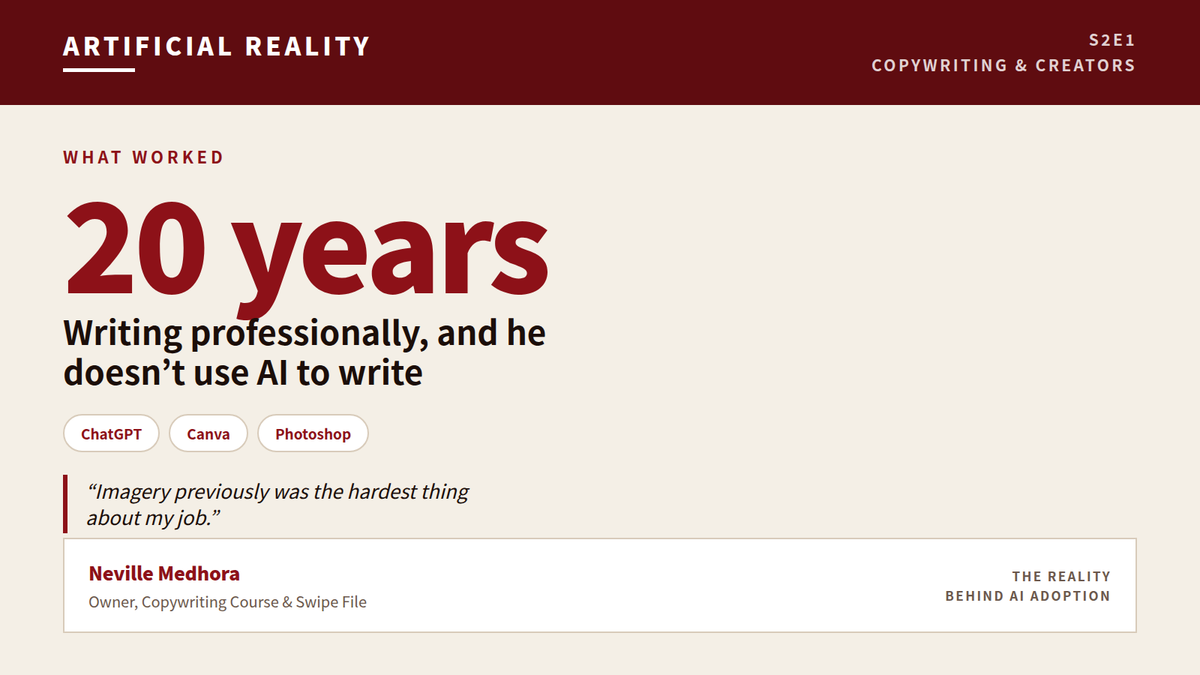
The most useful thing AI does for a professional writer has nothing to do with writing. Neville Medhora, a copywriter of twenty years who runs Copywriting Course and Swipe File, is explicit: "I am using it not to write my newsletter, not to replace my social media. I am using it to make a lot of images."
Why images
"Imagery previously was the hardest thing about my job. So I say every copywriter should also be able to make images. Use Canva, use Photoshop, use whatever you need, but you need to be able to make images because they're easy to understand. And now with AI, I can make a lot of images and I can customize them."
Note the logic. He did not pick the task AI does best. He picked the task that was most expensive for him and checked whether AI could do it — which is a better selection rule than most people use.
The method that separates usable from generic
"It can make some pretty damn good images if you kind of massage it in the right direction or give it inspiration to draw from. If you just say: hey, make an image of this — it makes kind of like an AI kind of whatever image."
Inspiration and direction produce something usable. A bare instruction produces the house style everyone now recognises on sight. If your generated images look generic, that sentence is the whole diagnosis.
Why he is not precious about it
"I've never been against AI. I think a lot of writers are like these curmudgeons, like you have to have a pen on paper type thing. I'm a copywriter. And what that means is I'm trying to make sales. So my ultimate goal is to make sales. And if writing a blog post is the best way to make sales, I'll do it. But if using AI to make a web page and write everything is the best way to make sales, I will do it as well."
He also has a longer memory than most: "This all used to be called machine learning… It's the exact same thing. The tech underlying is the same. It's just kind of a branding twist. The thing is, it's now a lot more useful to everybody."
What he still will not hand over
His archive business runs an automated pipeline that titles, describes, regenerates and categorises everything he saves. The selection stays his. "We tried to make AI go full bore and just run the whole thing and it kind of sucked."
What customers buy, in his words: "Neville's intuition of what would be a good ad."
The takeaway if you write for a living
- Point it at your most expensive task, not the most obvious one. For him that was images, not prose.
- Give it something to draw from. Reference and direction, not a bare instruction.
- Keep the judgment. It is what people pay for and what degrades first when you automate it.
AI tools named in this report
| Tool | Named by | Verdict | Used for |
|---|---|---|---|
| ChatGPT | Neville Medhora, owner, Copywriting Course & Swipe File | Worked | Image generation — his primary use |
| Canva | Medhora | Named as the baseline skill | Making images, pre-AI |
| Photoshop | Medhora | Named as the baseline skill | Making images, pre-AI |
| Ahrefs | Medhora | Worked | SEO data pulled into the pipeline |
| Google Trends | Medhora | Worked | Trend data pulled into the pipeline |
Tools named by the operator on the record. Inclusion is reporting, not endorsement.
Where this comes from
S2E1: AI should have killed his career. He's making $1M a year instead — the full interview with Neville Medhora. Listen or watch: YouTube, Spotify or Apple Podcasts.