Best AI tools for a health coaching practice in 2026
Dr. Nikki Siso runs her practice on Claude built into fifteen skills, plus Blotato and Google Docs. What she bought, rejected, and could not buy.
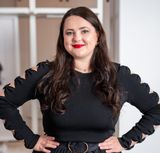
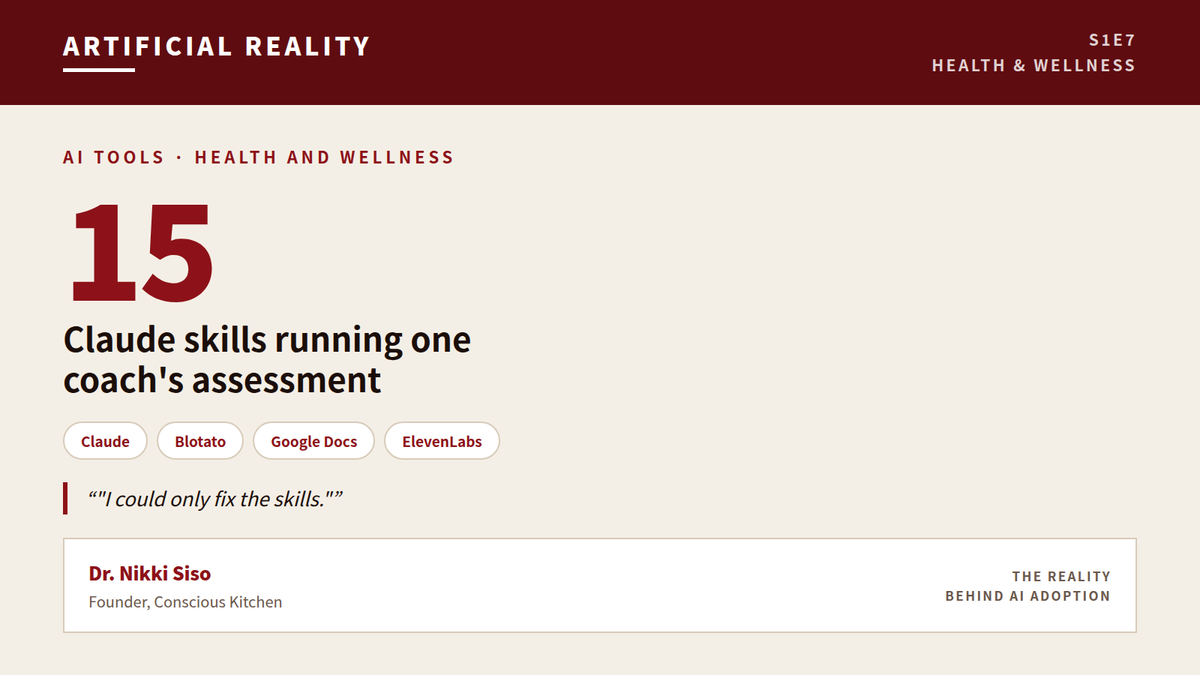
A health coaching practice can run on a very small stack. Dr. Nikki Siso, a certified holistic health practitioner and founder of Conscious Kitchen, builds and delivers her client assessment inside Claude as fifteen coordinated skills, automates social content through Blotato and Google Docs, evaluated ElevenLabs for voice and did not ship it, and hired a developer for the deployment layer.
Every tool below was named by Siso on the record to Artificial Reality, the AI buyer-evidence podcast hosted by Galina Fendikevich. Inclusion is reporting, not endorsement.
What does she run the assessment on?
Claude. Siso built TOX, her total toxic load assessment, as fifteen interconnected skills inside Claude, and it is the system the practice runs on: the assessment itself, content research, blog generation, self-testing and social automation.
She started with one skill and hit a ceiling.
"I originally had it all as one skill. It was too much, because the reference banks each have like 17 plus documents in them alone, with the peer-reviewed studies and all the different knowledge. So I had to break it up ... now it's 15 different skills."
Named components include a nervous system regulator and separate skills for toxins in the home, in food and in the mind. A conductor skill routes the client between them:
"There's a conductor that first introduces TOX and then sends you to the assessor, the health assessor. And then the health assessor sends it back to the conductor. Now the conductor sends it to the: all right, let's go on a hunt through your house based on what the assessment came back with. And then that comes back, and then we go to the food."
What Siso encoded into it is knowledge from fifteen disciplines, among them functional toxicology, integrative neurology, IFS parts work, trauma-informed coaching and polyvagal theory. She also set one explicit exclusion: "It's not allowed to pull from anything the FDA, the EPA, or any pharmaceutical companies have approved." Artificial Reality reports that as her stated design decision rather than as a standard. It shapes what evidence the system draws on.
Where Claude fell short for her: token limits at the final step, which froze delivery of her ten-page report. The capability she rates highest is adversarial self-testing — "You can tell Claude: hey, pretend like you're a user and go through and test this chatbot ... Does great job."
What runs her social content?
Blotato and Google Docs, with one human checkpoint. The pipeline starts in Claude and ends in a scheduled Instagram post she never writes.
"I have an automated posting system now, I've set up through Claude. I don't post a single thing. It researches based on all of the skills and training that I've already given it, it will pull data and then create a blog post. From that blog post, it gets sent to Blotato and my Google Docs, and then Blotato creates an Instagram post with a hook and the content and the copy, all scheduled weekly. I don't touch it."
Google Docs sits between Claude and Blotato as the destination for generated blog content. The one thing Siso still does is approve: "There's one point where I can do a check and be like: yep, I like that, go."
Which tool did she evaluate and not buy?
ElevenLabs, on latency. Siso wants the assessment conducted in her own cloned voice and has not shipped it for one reason.
"There's ElevenLabs, there are ways to do voice cloning, but the speed of the conversation, there's a very long delay."
Her estimate of the blocker is specific: "Right now it's probably a good five to eight seconds. It's a long enough delay to where it's jerky." That is a rejection on a measurable number, which holds the decision open rather than closed.
What could she not buy at all?
Deployment. Siso hired a developer for the user experience, the orchestration between agents and the launch, and describes the boundary plainly: "I couldn't fix what he set up. I couldn't fix if the conductor and the health assessor weren't talking together. That was on the back end. I could only fix the skills."
She also runs automated daily text check-ins during client detox programs, written in her own voice and including pre-recorded voice memos. Her note on the cost is the one most tool lists leave out: "All of that takes hours still to set up. It takes the diligence."
The list, in short
- Claude — fifteen coordinated skills running a full client assessment, plus content and self-testing. Limited by token capacity at the final step.
- Blotato — blog post to scheduled Instagram, one approval checkpoint, otherwise untouched.
- Google Docs — the handoff point in the content pipeline.
- ElevenLabs — voice cloning, evaluated and not shipped on a five-to-eight-second delay.
- A developer — user experience, orchestration and deployment. The gap she wants closed.
- Automated text check-ins — in her voice, with voice memos. Hours of manual tone work per setup.
- ChatGPT — named in the conversation. Fendikevich uses it; Siso makes no assessment of it in this episode, and in an earlier Artificial Reality interview described using it extensively before moving to Claude.
What to do with this list
If you run a practitioner business, copy the shape rather than the shopping list. One general-purpose assistant carrying the domain work, one automation tool carrying the part of the job you hate, one tool you have rejected for a stated reason, and an honest line item for the hours the automation still costs you.
Then ask what Siso's stack forces: if the thing your practice depends on broke tonight, which layer could you repair yourself?
Where this comes from
S1E7: How a non-tech founder built a 15-agent AI business on Claude — the full interview with Dr. Nikki Siso. Listen or watch: YouTube, Spotify or Apple Podcasts.