The content pipeline that turns one screenshot into a finished post
Neville Medhora's pipeline titles, describes, categorises and publishes in zero time — built with Codex, running on $8 a month, and he refuses to call it an agent.

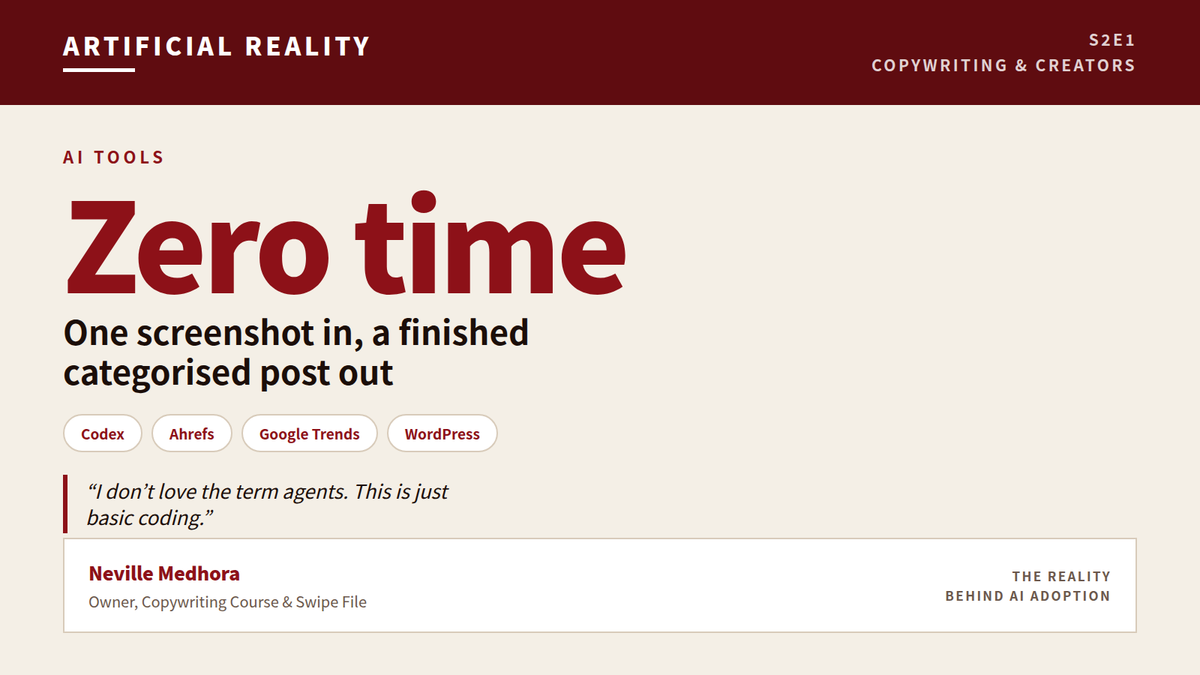
One screenshot goes in, and a titled, described, categorised post with six image variants and SEO keyword data comes out — with no human step in between. Neville Medhora, who runs Swipe File, built that pipeline himself and refuses to call it an agent. “I don’t love the term agents. This is just basic coding, right?”
What does the pipeline actually do?
Medhora’s own description of what happens when he saves a marketing example:
“I just take a screenshot, tell Swipe File to take it, it titles it, it describes it, it regenerates the image in six different ways. It pulls from Ahrefs SEO data and it does all the keywords. And then it also pulls Google Trends data. It does all of those, finds related posts, and it categorizes it.”
The same pipeline runs off an Instagram save. Pressing save on a post triggers the archive, the embed, the description and the storage.
The outcome he reports: “What used to take me a few minutes to make a very basic post… now takes me zero time.”
Which tools are wired into it?
Four, and only one of them is a product he interacts with.
- The AI model — image description and regeneration, six variants per item
- Ahrefs — SEO keyword data, pulled by API
- Google Trends — trend data, pulled by API
- WordPress — where the finished post lands
Ahrefs and Google Trends are the interesting entries, because he never opens them. They are inputs to the pipeline, not tools on his desk.
What did it replace?
The work he was worst at enjoying. “I got to get rid of titling stuff and categorizing stuff and manually uploading it to WordPress… And I just get to do what I’m good at and take screenshots and it’s done.”
Note what he did not automate: choosing which example is worth saving. He tried. “We tried to make AI go full bore and just run the whole thing and it kind of sucked.”
Why does he reject the word “agent”?
Because it describes packaging, not capability. He has built the thing the category is named after — he says he has “done the agents thing” — and expects the label to fade while the automation stays. From his side of it, this is a script that calls some APIs and writes to a CMS.
That matters if you are being sold an agent platform. Ask what the platform does that a scheduled script calling two APIs does not.
What does it cost to run?
The delivery layer is $8 a month to Bunny.net, for what he describes as millions to tens of millions of images. The AI is a $20 consumer ChatGPT subscription. The pipeline itself was built with Codex.
AI Tools Named in This Report
| Tool | Named by | Verdict | Used for | What he said |
|---|---|---|---|---|
| Codex | Neville Medhora, owner, Swipe File | Worked | Building the pipeline | “ChatGPT, Codex for coding” |
| ChatGPT | Medhora | Worked | Image description and regeneration | “$20 ChatGPT subscription” |
| Ahrefs | Medhora | Worked | SEO keyword data via API | “It pulls from Ahrefs SEO data” |
| Google Trends | Medhora | Worked | Trend data via API | “It also pulls Google Trends data” |
| WordPress | Medhora | Worked | Publishing target | “Manually uploading it to WordPress” — now automated |
| Bunny.net | Medhora | Worked | Image delivery, $8/mo | “I serve millions, tens of millions of images per month” |
Tools named by the operator on the record. Inclusion is reporting, not endorsement.
If you’re building something similar
Automate the step you resent, not the step you’re paid for. He removed titling and uploading. He kept selection.
Wire data sources in, don’t add dashboards. Ahrefs and Google Trends became inputs, not another two tabs.
Build it where it’s cheap. The pipeline came out of a coding agent, not a platform subscription.
Where this comes from
S2E1: AI should have killed his career. He's making $1M a year instead — the full interview with Neville Medhora. Listen or watch: YouTube, Spotify or Apple Podcasts.