Best AI tools for copywriters, from a $1M solo business
Neville Medhora runs a $1M-a-year copywriting business on a $20 ChatGPT subscription. The full stack, what each tool does, and what he refuses to buy.

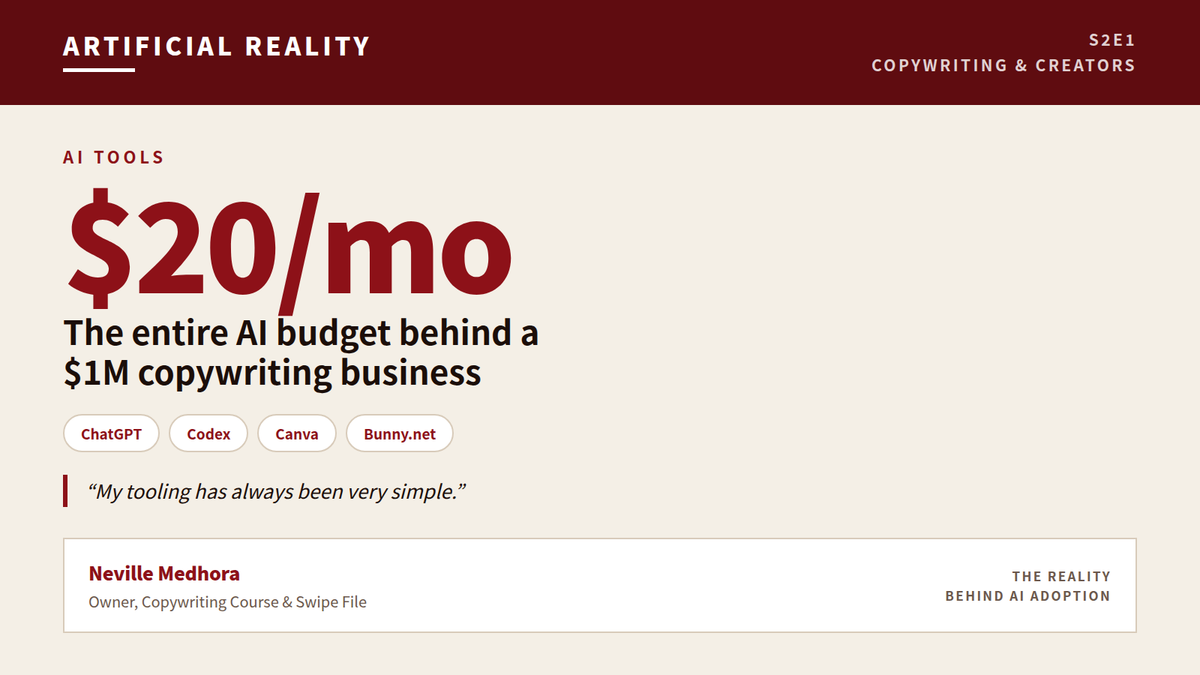
A working copywriter with an AI-dependent business runs almost no AI tools. Neville Medhora, who owns Copywriting Course and Swipe File and does roughly $1M a year, uses a consumer ChatGPT subscription at $20 a month and Codex for coding. That is the stack.
Asked directly what he uses, he said: “My tooling has always been very simple, and it’s generally ChatGPT, Codex for coding, and then just like a basic $20 ChatGPT subscription.”
What does he use ChatGPT for?
Images, not writing. This is the part most people get backwards.
“I am using it not to write my newsletter, not to replace my social media. I am using it to make a lot of images.”
His reasoning is specific to the job: “Imagery previously was the hardest thing about my job. So I say every copywriter should also be able to make images… you need to be able to make images because they’re easy to understand.”
He does use it for first-draft sales pages under deadline, and is candid that this is a trade-off rather than an upgrade.
What does he use for coding?
Codex, OpenAI’s coding agent. He also works with a developer who runs a wider set of tools — “he uses all the different tools and stuff like that.”
That division is the practical shape of his operation: a minimal, cheap, generalist stack for him, specialist tooling with the person who actually needs it.
Does he use Claude or Grok?
Yes, and he tests across all three — but ChatGPT is the default.
“They’re all almost the same, is my opinion. I use all of them and I try prompts out on different ones.”
His argument for not agonising over it: “For the average person, all these tools are within three months of each other… the benchmarks are slightly different for the regular plebs like me.” He settled on ChatGPT because “the markup and everything gives me the best results and it’s just the easiest to use.”
That is a description of his practice, not an endorsement. His stated position is that for a non-specialist the frontier models are close enough that picking one and staying is rational.
What runs the rest of the business?
The non-AI tools do more work than the AI ones.
- Kit (formerly ConvertKit) — email, roughly 100,000 tagged subscribers
- WordPress — the publishing substrate for Swipe File
- Bunny.net — media delivery, $8 a month for what he describes as millions to tens of millions of images
- Ahrefs and Google Trends — SEO and trend data, pulled automatically inside his pipeline rather than used by hand
- Google Keep — note-taking, which he calls one of Google’s best products
- Calendly — which he argues most businesses need before they need any AI
- Canva and Photoshop — the pre-AI design floor, named as a capability rather than a vendor
AI Tools Named in This Report
| Tool | Named by | Verdict | Used for | What he said |
|---|---|---|---|---|
| ChatGPT | Neville Medhora, owner, Copywriting Course & Swipe File | Worked | Image generation, draft sales pages | “Just like a basic $20 ChatGPT subscription” |
| Codex | Medhora | Worked | Coding | “ChatGPT, Codex for coding” |
| Claude | Medhora | Worked | Cross-model prompt testing | “They’re all almost the same, is my opinion” |
| Grok | Medhora | Worked | Cross-model prompt testing | Named in the same comparison |
| Gemini / Nano Banana | Medhora | Worked, then switched away | Image generation | “Nano Banana came out. We switched to that” |
| Kit | Medhora | Mixed | Email, ~100k subscribers | Abandoned its MCP connector in two weeks |
| Ahrefs | Medhora | Worked | SEO keyword data, via API | “It pulls from Ahrefs SEO data” |
| Google Trends | Medhora | Worked | Trend data, via API | “It also pulls Google Trends data” |
| Perplexity, Lovable, Supabase | Galina Fendikevich (host) | — | — | Named by the host, not Medhora |
Tools named by the operator on the record. Inclusion is reporting, not endorsement.
How to read this stack if you’re choosing tools
Note what’s missing. No dedicated AI writing tool. No agent platform. No content-marketing suite.
The automation is custom, not purchased. His pipeline was built, not bought — and he declines to call it an agent.
Model choice is deliberately shallow. He switches image models when one pulls ahead and expects to switch again. That only works because nothing in his workflow is tightly coupled to a vendor.
The price is the headline. A $20 subscription and $8 of bandwidth, running a business he describes as doing a million a year.
The Artificial Reality take
The expensive, differentiated part of his operation is the part AI never touched. He automated titling, describing, categorising and uploading — the work he liked least. What he sells is judgment about which ad is worth saving.
He tested the alternative and reports it failed: “we tried to make AI go full bore and just run the whole thing and it kind of sucked.”
If you are assembling a stack from this: the tool list is nearly free, the pipeline was built rather than bought, and the thing customers pay for sits outside both.
Where this comes from
S2E1: AI should have killed his career. He's making $1M a year instead — the full interview with Neville Medhora. Listen or watch: YouTube, Spotify or Apple Podcasts.