Forty-five minutes of disclosure, and then no report at all
A client finished a forty-five-minute AI health assessment and got silence. What broke, what it cost, and five checks before you ship one.

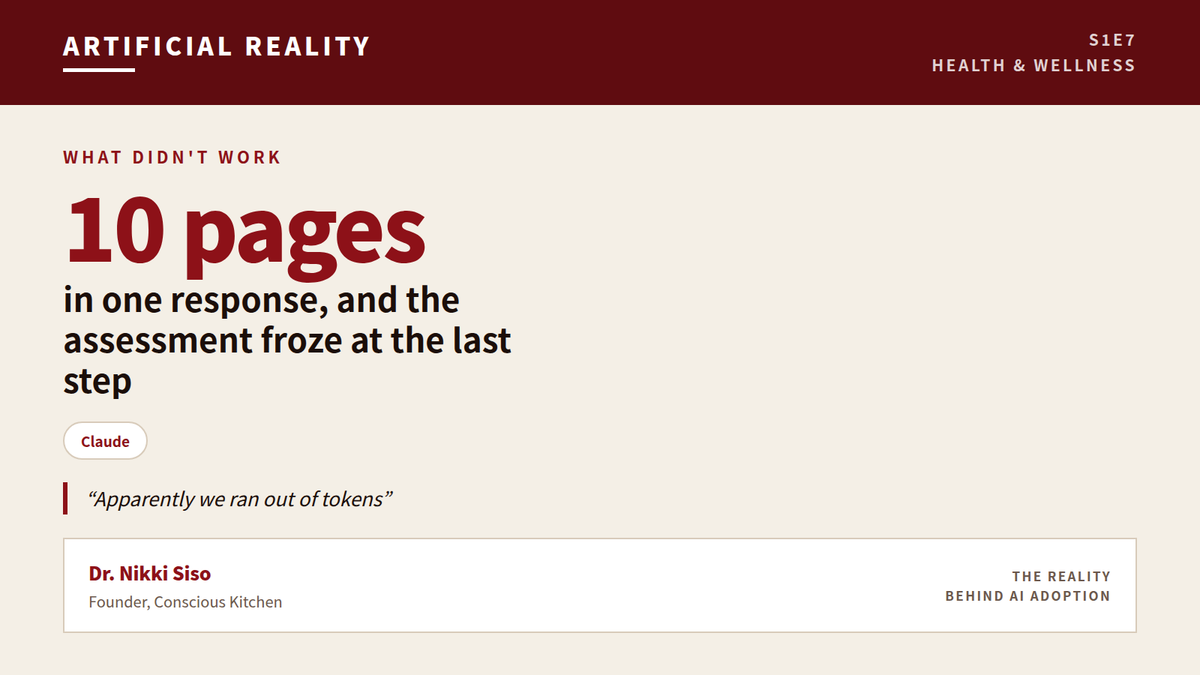
The most damaging AI failure in Dr. Nikki Siso's health practice was not a wrong answer. It was silence. A client finished her forty-five-minute assessment and nothing arrived, because the system was trying to deliver a ten-page report, a private practitioner briefing and a JSON payload in one response, and froze.
Her account of the moment:
"It would stop midway and just stop, and we're like: what happened."
What actually broke?
The final response was too large. Siso's diagnosis, in her words: "Apparently we ran out of tokens." The cause was that she had stacked three outputs onto one instruction.
"It was not only the report, but also I get a for-my-eyes-only — I've trained it to write a report for me of what this person really needs and supports me as well. And also a JSON. So it had three instructions at the end and then it would just freeze."
Her fix was architectural rather than clever:
"The report is ten pages long. Well, I just figured out that it was too much to put as a final response in the chat. It needs to be taken off the chat and done on the back end and then sent as an email."
Why is a timeout worse in a coaching practice than in most software?
Because of what the client had just done. They had spent forty-five minutes disclosing personal health information, childhood material and household detail, and the reward for that was nothing.
"And then it was freaky, because we thought: this person just took 45 minutes to go through this full assessment, and where's the report?"
In most software a timeout is an inconvenience. In a practice built on being heard, Artificial Reality, the AI buyer-evidence podcast hosted by Galina Fendikevich, would put it differently: the failure mode was the exact injury the service exists to prevent. Design your failure modes against the relationship, not against the system.
Was it one prompt and done?
No, and Siso is blunt about it. Asked about the advertising slogan on the New York subway — one prompt, job done — she answered:
"No, not at all. This took me hours — hundreds of hours to put together."
Where the hours went:
"Even with the research — finding all the different studies and then adjusting them, and when I say adjusting, meaning selecting what needs to be in there, and then adjusting the tone, and then adjusting the languaging. Because it would come out as this long bulk text chatbot and it's too much to read, and I had to shorten that, and then it got too short ... it's a continuous stream of fixes."
Her own family expects otherwise, which is most people's expectation: "My mother thinks it's like this one-prompt-job-done thing. And I'm: no."
Is she working less?
She reports working more, and she volunteers it rather than being pressed:
"I'm now working like 10 people, but I'm actually doing more. I'm working harder now that I've had AI. Because the power of it is so fascinating and so addictive that I can create all the things that before weren't possible for me, or would have needed a much larger budget or a team of 10. So now I can actually do all these ideas that I have in my head. But now I'm working on all of them, and it does still take hours to put together."
The intake itself got faster — hours of manual work down to a forty-five-minute assessment. The business around it got busier, because the range of things now possible expanded faster than the time each one takes contracted.
Five checks before you put an AI assessment in front of a client
Artificial Reality's read of what Siso's failures point to, drawn from her account rather than from a vendor's checklist:
- One output per response. Her freeze came from asking for three deliverables at once.
- Deliver long documents off the chat. Her own conclusion: the ten-page report belongs on the back end and in an email.
- Test the end of the flow, not the start. The failure was at the last step, after the client had already invested forty-five minutes.
- Decide what the client sees when it breaks. Silence was the default, and silence was the damage.
- Budget in hundreds of hours, not one prompt. Tone, length and source selection were a continuous stream of fixes, by her account.
What to do this week
If you are running any AI process that ends with a person waiting for something, go and break it on purpose today. Ask for the largest output your worst case would generate and watch what happens at the final step.
Then decide, before it happens to a client, what the fallback is: a short holding message, a human alert, an email that arrives later. Siso found her answer only after a real client had already sat in the silence.
Where this comes from
S1E7: How a non-tech founder built a 15-agent AI business on Claude — the full interview with Dr. Nikki Siso. Listen or watch: YouTube, Spotify or Apple Podcasts.